
Crude drug sample data base
※Click on the image to enlarge it.
Crude drug name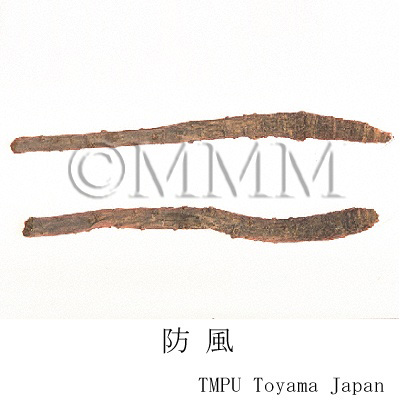 | Market name | 防風 |
|---|---|---|
| Formal name | 防風 | |
| Japanese name | ぼうふう, Bōhū | |
| Vernacular name | Fangfeng | |
| Latin name | Saposhnikoviae Radix (JP), (CP) | |
| English name | Saposhnikovia Root and Rhizome (JP), Divaricate Saposhnikovia Root (CP) | |
| Original plant name | Saposhnikovia divaricata (Turcz.) Schischkin | |
| Family name | Umbelliferae | |
| Used part | Classification | Plant origin | Sub classification | root |
| Collection information | Hong Kong, Wing Tai Hong Medicine Co.,Ltd. | |
| Collection date | 1974/12/25 | |
| TMPW No. | 1044 | |
Scientific information data base
| Common name | 防風, Fangfeng, Saposhnikoviae RadixJP,CP, Saposhnikovia Root and RhizomeJP, Divaricate Saposhnikovia RootCP | |||||
|---|---|---|---|---|---|---|
| Synonyms | 真防風, 関防風, 東防風, 山防風 | |||||
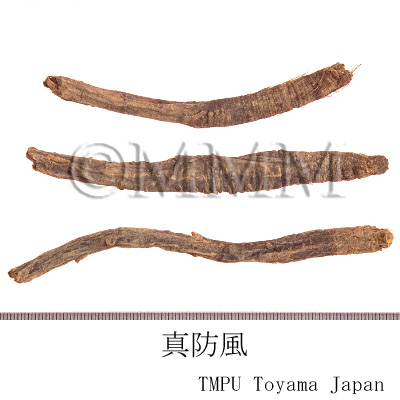
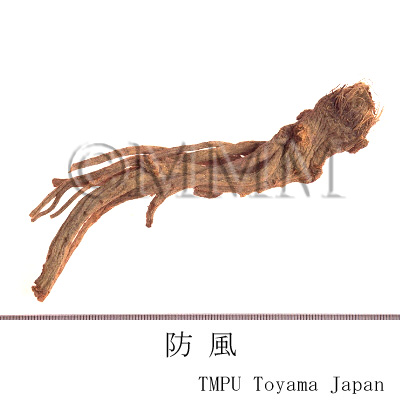
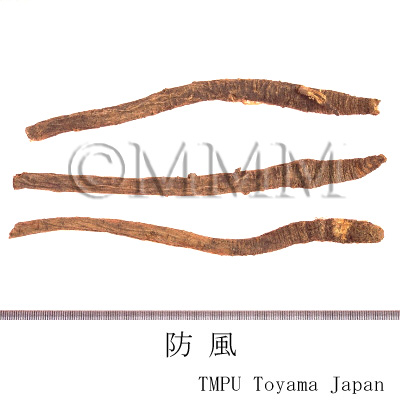
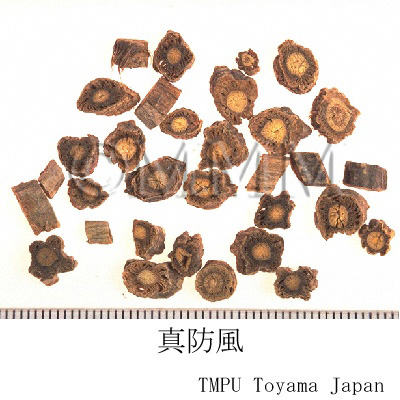
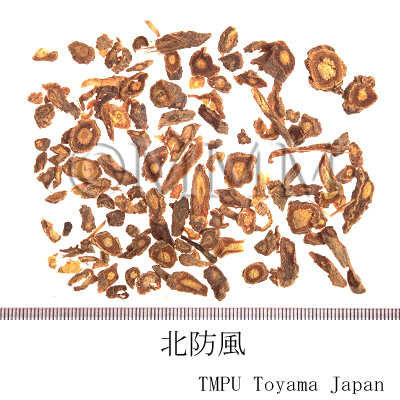
| crude drug image |
| |||||
| Original plant name | Saposhnikovia divaricata Schischkin [Saposhnikovia divaricata (Turcz.) Schischkin (= Ledebouriella seseloides auct. non H. Wolff)] | |||||
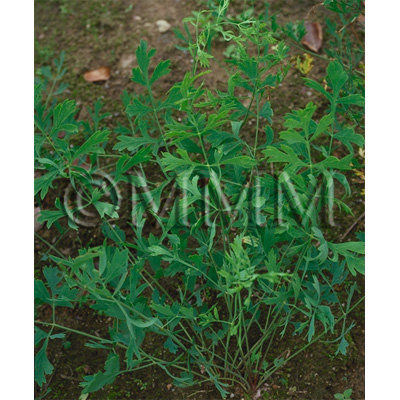
| original plant image |
| |||||
| Family name | Umbelliferae | |||||
| Used part | root (and rhizome) | |||||
| Quality for selection | The ones with a pale yellow surface, a well-filled interior, and a thick and long shape are considered to be of good quality. The root head usually bears dark brown, fibrous remnants of basal leaves (TN). | |||||
| Official compendium | JP XIX, CP (2025 ed.) | |||||
| Clinical application | It is used as a diaphoretic, carminative, antipyretic, and analgesic agent for the common cold, headache, fever with anhidrosis, arthralgia, limb spasms, and tetanus. | |||||
| Medical system | Traditional Chinese medicine | |||||
| Drug effect in traditional medicine | Traditional classification | Diaphoretics with warm property | ||||
| Beneficial effect | [Property and Flavor] Mild warm; pungent and sweet. [Meridian Tropism] Bladder, liver and spleen meridians. [Actions] To dispel wind to release the exterior pattern, dispel dampness and relieve pain, arrest convulsions. [Indications] Common cold, headache, painful impediment caused by wind-dampness, itching caused by rubella, tetanus. | |||||
| Chemical constituent | Monosaccharides (*C2): D-Mannitol Terpenoids (Essential oils) (*C2): 精油 Chromones (*C1): 5-O-Methyl visamminol, Cimifugin, Hamaudol,それらの glucoside Coumarins (*C1): Deltoin | |||||
| Chemical structure |   
※画像をクリックすると、拡大して表示されます。 | |||||
| Pharmacological effect | Antipyretic (decoction). | |||||
| DNA sequence | AF077878, U58553, U78377, U78437, AF164833, AF169280, AF169281, AF169282, AF169283; Traditioal Medical & Parmaceutical Database. | |||||
| Classical reference (Chinese Herbal Classic "Zhenglei bencao") | 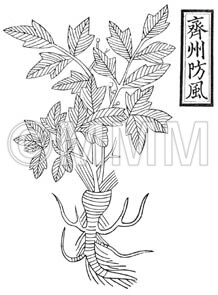 ※Click this image to see the actual image ※Click this image to see the actual image | |||||
| Disease | Common cold, Fever, Chill, Headache, Somatic pain, Swelling and pain of joint, Twitch of the muscles, Convulsion, Itching, Tetanus | |||||
| Formulation | Orenshodokuin, Kamihassento, Gyokuheifusan, Kufugedokusan, Kufushokutsuto, Keigairengyoto, Keigairengyoto, Keishishakuyakuchimoto, Shijunseiryoin, Shaito, Jumizasan, Jumihaidokuto, Shozokumeito, Shofusan, Jokinritsuansan, Joyowaketsuto, Shin'isan, Jingyobofuto, Jintanto, Seiinrikakuto, Seishitsuto, Seijokentsuto, Seijobofuto, Seiryoin, Senkanmeimokuto, Senkyuchachosan, Sokeikakketsuto, Daisangoshichisan, Daibofuto, Chikuyoto, Jizusoippo, Chotosan, Tokiinshi, Tokinentsuto, Naitaku-san, Naitaku-san, Boijioto, Bofutsushosan, Rikkosan, Ryutan-shakan-to, Meiganippo | |||||
| Related drugs | Glehuniae Radix cum Rhizoma | |||||
| References | JP: The 19th edition of the Japanese Pharmacopoeia. CP: Pharmacopoeia of the People's Republic of China 2025 edi. C1) The Encyclopedia of Wakan-Yaku with Color Pictures Vol. I, pp 82-83. C2) Outline of Pharmacognosy, a Textbook, p 258. | |||||
| Remarks | The roots of Ligusticum brachylobum Franch.(Jap. name: Senbohū), Seseli mairei Franch. or Seseli yunnanense Franch. (Jap. name: Unbohū) are used in substitution for "Fangfeng". In Japan the root or rhizome of Glehnia littoralis F. Schmidt et Miquel is occasionally used for its substitute. | |||||
| Last renewal date | 2026/07/14 | |||||