
Crude drug sample data base
※Click on the image to enlarge it.
Crude drug name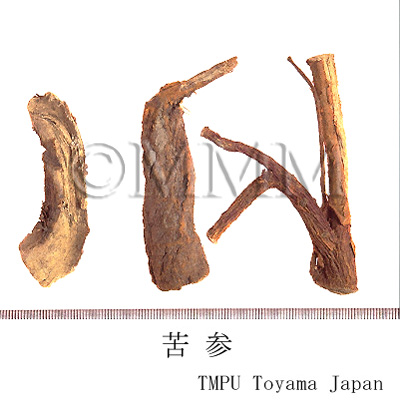 | Market name | 苦参 |
|---|---|---|
| Formal name | 苦参 | |
| Japanese name | くじん, Kujin | |
| Vernacular name | Kushen | |
| Latin name | Sophorae Radix (JP), Sophorae Flavescentis Radix (CP) | |
| English name | Sophora Root (JP), Lightyellow Sophora Root (CP) | |
| Original plant name | Sophora flavescens Aiton, (Kurara) | |
| Family name | Leguminosae | |
| Used part | Classification | Plant origin | Sub classification | root |
| Collection information | Japan, Osaka Pref. , Tochimoto Tenkaido Co., Ltd. | |
| Collection date | 1957/00/00 | |
| TMPW No. | 1079 | |
The capital city, provincial capital city or the representative
location of its administrative area is indicated.
Production area information
https://ethmed.toyama-wakan.net/img/pin_san.png
34.6937378
135.50216509999996
Collection information
Japan,Osaka Pref.
https://ethmed.toyama-wakan.net/img/pin_nyu.png
Scientific information data base
| Common name | 苦参, Kushen, Sophorae RadixJP, Sophorae Flavescentis RadixCP, Sophora RootJP, Lightyellow Sophora RootCP | |||||
|---|---|---|---|---|---|---|
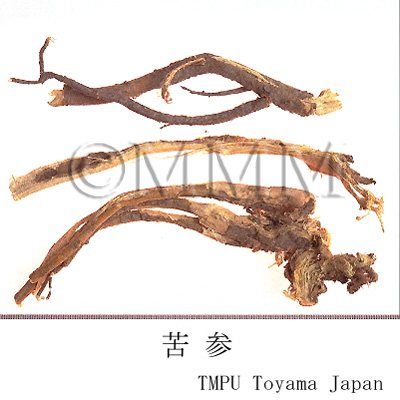
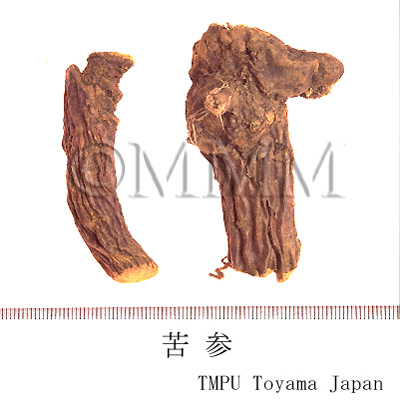
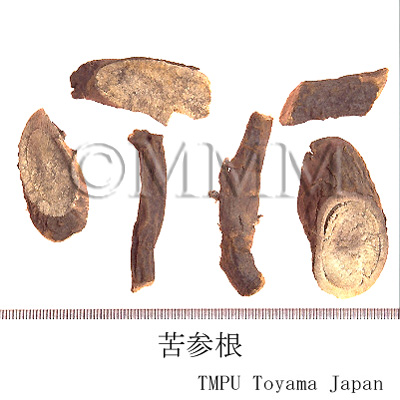
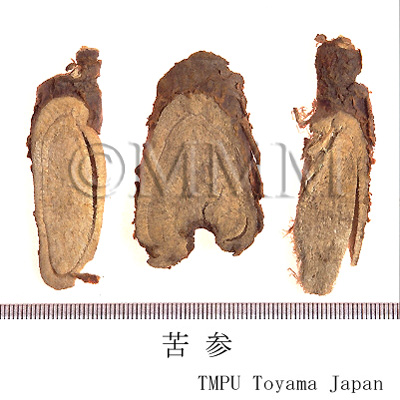
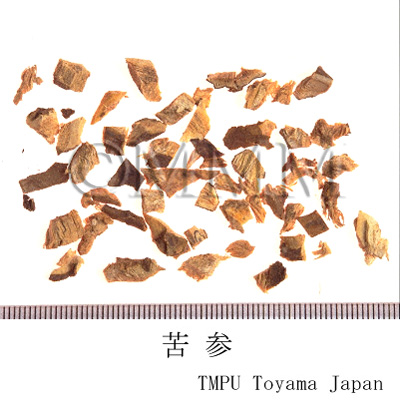
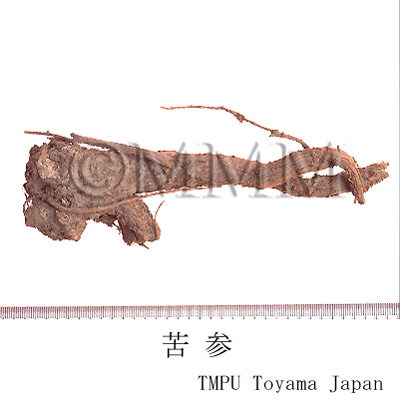
| crude drug image |
| |||||
| Original plant name | Sophora flavescens Aiton, (Kurara) | |||||
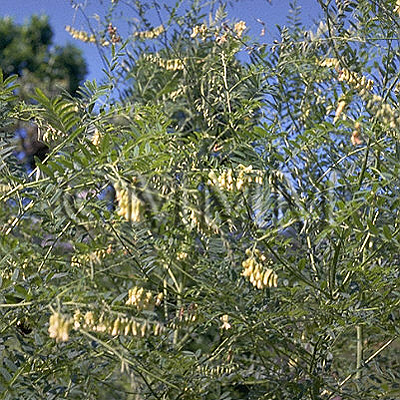
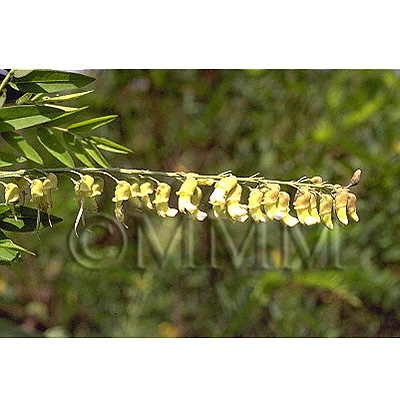
| original plant image |
| |||||
| Family name | Leguminosae | |||||
| Used part | root (often without periderm) | |||||
| Quality for selection | Long, with few bends, a yellowish-white inner surface, and a strong bitter taste are considered desirable qualities (TN). | |||||
| Official compendium | JP XIX, CP (2025 ed.) | |||||
| Clinical application | It is used as a bitter stomachic, antipyretic, diuretic, choleretic, anti-inflammatory, and antidiarrheal agent. It is applied to conditions such as skin disorders caused by blood heat in the hands and feet, stomatitis, bacterial diarrhea, enteritis, and difficulty in urination. It is also used externally to treat eczema and parasitic skin diseases. | |||||
| Medical system | Traditional Chinese medicine | |||||
| Drug effect in traditional medicine | Traditional classification | Drugs for elimination heat and dampness | ||||
| Beneficial effect | [Property and Flavor] Cold; bitter. [Meridian Tropism] Heart, stomach, large intestine and bladder meridians. [Actions] To clear heat and dry dampness, kill worms, disinhibit urine. [Indications] Heat dysentery, bloody stool, jaundice with annuria, red or white vaginal discharge, pudendal swelling and itch, eczema, dampness sore, itching of skin, scabies and tinea leprosy; Topical application, trichomonas vaginitis. | |||||
| Chemical constituent | Sterols (*C1): beta-Sitosterol, Stigmasterol, Campesterol Flavanones & Dihydroflavonols (*C2): Kurarinol, Kurarinone, Kuraridinol, Norkurarinol Isoflavones (*C1): Trifolirhizin Alkaloids (*C1): Matrine, Oxymatrine, Sophoranol, Anagyrine, Methylcytisine, Baptifoline, Sophocarpine, Isomatrine | |||||
| Chemical structure |    
※画像をクリックすると、拡大して表示されます。 | |||||
| Pharmacological effect | It inhibits stress-induced ulcers (matrine and oxymatrine fractions), impairs voluntary motor activity, and inhibits the vasomotor center (matrine). It also exhibits antifungal activity against various dermatophytes that cause cutaneous ringworm infections (decoction). | |||||
| DNA sequence | AF123452; Traditioal Medical & Parmaceutical Database. | |||||
| Classical reference (Chinese Herbal Classic "Zhenglei bencao") | 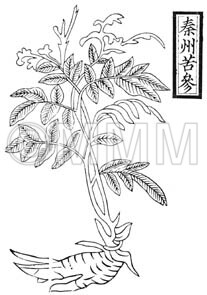 ※Click this image to see the actual image | |||||
| Disease | Diarrhea, Hematochezia, Bleeding hemorrhoids, Jaundice, Itching, Leukorrhea, Oliguria | |||||
| Formulation | Sammotsuogonto, Shofusan, Tokinentsuto, Tokibaimokujingan | |||||
| References | JP: The 19th edition of the Japanese Pharmacopoeia. CP: Pharmacopoeia of the People's Republic of China 2025 edi. C1) The Encyclopedia of Wakan-Yaku with Color Pictures Vol. I, p 106. C2) Outline of Pharmacognosy, a Textbook, p 287. | |||||
| Remarks | It is used as an ingredient in household medicines. | |||||
| Last renewal date | 2026/11/06 | |||||