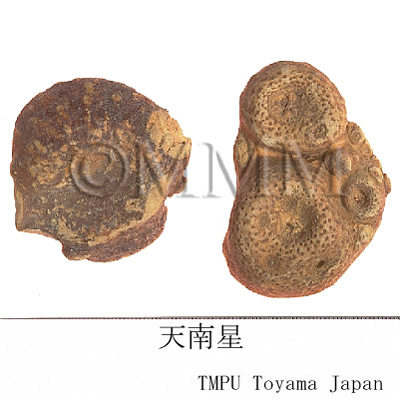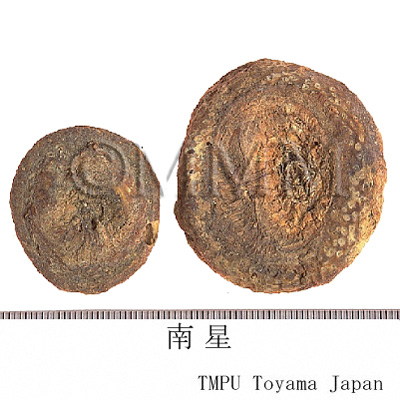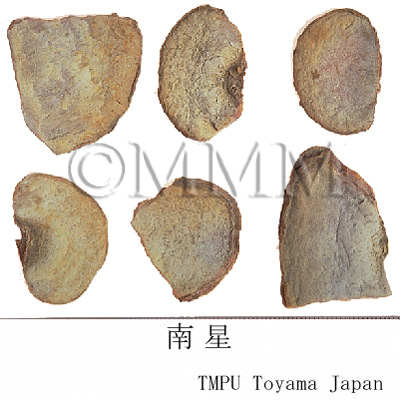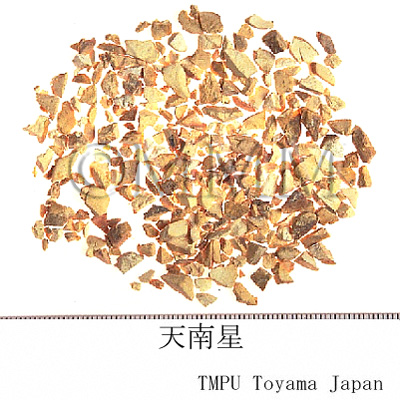

Crude drug sample data base
※Click on the image to enlarge it.
Crude drug name | Market name | 天南星 |
|---|---|---|
| Formal name | 天南星 | |
| Japanese name | てんなんしょう, Tennanshō | |
| Vernacular name | Tiannanxing | |
| Latin name | Arisaematis Tuber (Non-JPS), Arisaematis Rhizoma (CP) | |
| English name | Arisaema Tuber (Non-JPS), Jackinthepulpit Tuber (CP) | |
| Original plant name | Arisaema heterophyllum Blume1, Arisaema consanguineum Schott, (Maizurutennanshō1) or other species of the same genus | |
| Family name | Araceae | |
| Used part | Classification | Plant origin | Sub classification | tuber |
| Collection information | People's Republic of China, Beijing , Beijing Medical University | |
| Collection date | 1981/03/02 | |
| TMPW No. | 1121 | |
The capital city, provincial capital city or the representative
location of its administrative area is indicated.
location of its administrative area is indicated.
Production area information
https://ethmed.toyama-wakan.net/img/pin_san.png
39.90419989999999
116.40739630000007
Collection information
People's Republic of China,Beijing
https://ethmed.toyama-wakan.net/img/pin_nyu.png
Scientific information data base
| Common name | 天南星, Tiannanxing, Arisaematis TuberNon-JPS, Arisaematis RhizomaCP, Arisaema TuberNon-JPS, Jackinthepulpit TuberCP | |||||
|---|---|---|---|---|---|---|
| crude drug image |
| |||||
| Original plant name | Arisaema heterophyllum Blume1, Arisaema erubescens Schott, Arisaema amurense Maximowicz, (Maizurutennanshō1) or other species of the same genes, | |||||
| original plant image |
| |||||
| Family name | Araceae | |||||
| Used part | tuber (without cork layer) | |||||
| Quality for selection | Those that are round, plump, and white inside are considered to be of good quality (NI). | |||||
| Official compendium | Non-JPS (2022), CP (2025 ed.) | |||||
| Clinical application | It is used as an antispasmodic, expectorant, and dampness-resolving agent for conditions such as wind stroke, hemiplegia following stroke, trismus with rigidity, tetanus, and febrile convulsions in children. In folk medicine, the powdered form is also applied externally to sores and wounds for its analgesic and swelling-reducing effects. | |||||
| Medical system | Traditional Chinese medicine | |||||
| Drug effect in traditional medicine | Traditional classification | Expectorants | ||||
| Beneficial effect | [Property and Flavor] Warm; bitter and pungent; toxic. [Meridian Tropism] Lung, liver and spleen meridians. [Actions] To dissipate bind and disperse swelling. [Indications] Topical application: swelling abscess and bites of insects, worms or snakes. | |||||
| Chemical constituent | Polysaccharides (*C1): 澱粉 [starch] Others (*C1): サポニン [saponin], シュウ酸カルシウム [calcium oxalate] | |||||
| DNA sequence | AF274295, AF291914, AJ005629; Traditioal Medical & Parmaceutical Database. | |||||
| Classical reference (Chinese Herbal Classic "Zhenglei bencao") |  ※Click this image to see the actual image | |||||
| Disease | Cough, A lot of sputum, Feeling of pressure in the chest, Vertigo, Partial paralysis, Facial palsy, Numbness, Tetanus, stiffness in the back, Pyogenic dermatosis, Enlarged lymph nodes, Snake bite | |||||
| Formulation | Sanshoin, Jokinritsuansan, Seishitsuketanto, Nijutsuto | |||||
| References | Non-JPS: The Japanese standards for non-Pharmacopoeial crude drugs 2022. CP: Pharmacopoeia of the People's Republic of China 2025 edi. C1) The Encyclopedia of Wakan-Yaku with Color Pictures Vol. I, pp 35-36. | |||||
| Remarks | Botanical Origin: Japanese Arisaema Tuber is the bulb of Arisaema ringens (Thunb.) Schott (Jap. name: "Musashiabumi", products of Kyūshū island), A. japonicum Blume (Jap. name: "Mamushigusa"), A. japonicum Blume var. atropureum (Engl.) Kitamura (Jap. name: "Kōraitennanshō"). They are sliced, coated with lime and dried. Medicinal Benefits: Wang Haogu described in his writing Tangyebencao (Jin Dynasty) that both Arisaema Tuber and Pinellia Tuber have the same beneficial effect in resolving phlegm. Indeed, Pinellia Tuber is also pungent but it exclusively removes damp phlegm from the spleen and stomach. Arisaema Tuber is used for damp phlegm of the spleen and the stomach as well, and it is used to relieve symptoms which are caused by damp phlegm and phlegmatic syndrome due to wind invading the meridian. That is, palsy, paralysis, trismus, stiffness of the body, contracture of muscles and blood vessels, epilepsy induced by terror and tetanus. | |||||
| Last renewal date | 2026/10/09 | |||||