

Crude drug sample data base
※Click on the image to enlarge it.
Crude drug name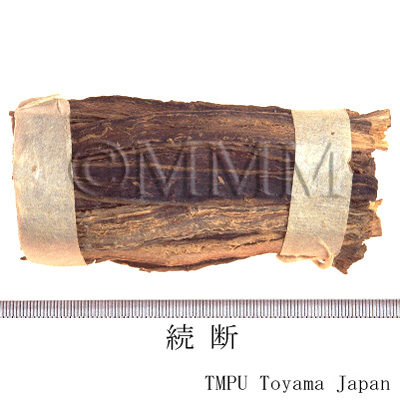 | Market name | 続断 |
|---|---|---|
| Formal name | 続断 | |
| Japanese name | ぞくだん, Zokudan | |
| Latin name | Dipsaci Radix (CP) | |
| English name | Himalayan Teasel Root (CP), Dipsaci Root | |
| Original plant name | Dipsacus asperoides C.Y. Cheng et T.M. Ai | |
| Family name | Dipsacaceae | |
| Used part | Classification | Plant origin | Sub classification | root |
| Production area information | People's Republic of China | |
| Collection information | Japan, Osaka Pref. , Tochimoto Tenkaido Co., Ltd. , Tochimoto Tenkaido Co., Ltd. | |
| Collection date | 1979/01/00 | |
| Remarks | Natural Medicines, 48(2),131 (1994) | |
| TMPW No. | 1136 | |
The capital city, provincial capital city or the representative
location of its administrative area is indicated.
location of its administrative area is indicated.
Production area information
People's Republic of China
https://ethmed.toyama-wakan.net/img/pin_san.png
34.6937378
135.50216509999996
Collection information
Japan,Osaka Pref.
https://ethmed.toyama-wakan.net/img/pin_nyu.png
Scientific information data base
| Common name | 続断, Xuduan, Dipsaci RadixCP, Himalayan Teasel RootCP, Dipsacus Root | |||
|---|---|---|---|---|
| Synonyms | 川続断 (Chuanxuduan) | |||
| crude drug image |
| |||
| Original plant name | Dipsacus asperoides C.Y. Cheng et T.M. Ai | |||
| Family name | Dipsacaceae | |||
| Used part | root | |||
| Quality for selection | Large and firm perennial roots are considered to be of good quality, whereas soft newly developed roots are considered inferior (NI). | |||
| Official compendium | CP (2025 ed.) | |||
| Clinical application | It is used as a tonic, analgesic, and anti-inflammatory agent for the treatment of lower back pain, inflammation associated with traumatic injuries, wounds, and fractures. It promotes tissue regeneration, lactation, and hemostasis. It is also used for the treatment of threatened miscarriage. | |||
| Medical system | Traditional Chinese medicine | |||
| Drug effect in traditional medicine | Traditional classification | Replenishing Yang(vital function) drugs | ||
| Beneficial effect | [Property and Flavor] Mild warm; bitter and pungent. [Meridian Tropism] Liver and kidney meridians. [Actions] To tonify liver-kidney, strengthen sinew and bone, reconnect fracture, stop flooding and spotting. [Indications] Deficiency of liver-kidney, soreness and weakness in the low back and knees , painful impediment caused by wind-dampness, injuries from falls. sinew injury and fracture, flooding and spotting, vaginal bleeding during pregnancy. | |||
| Chemical constituent | Others (*C1): アルカロイド、精油が含まれているといわれるが、詳細不明。 Alkaloids and essential oils have been reported, but the constituents have not been fully characterized. | |||
| Classical reference (Chinese Herbal Classic "Zhenglei bencao") | 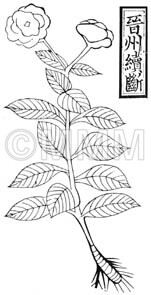 ※Click this image to see the actual image ※Click this image to see the actual image | |||
| Disease | Heaviness and powerlessness in lumber and knee, Leg weakness, Arthralgia, Numbness, Contusion, Sprain, Fracture, Irregular vaginal bleeding, Lower abdominal pain during pregnancy, Threatened abortion | |||
| Formulation | rarely used in formula | |||
| References | CP: Pharmacopoeia of the People's Republic of China 2025 edi. C1)The Encyclopedia of Wakan-Yaku with Color Pictures Vol. I, pp 185-186. | |||
| Remarks | In the market, Xuduan is called "Chuanxuduan" (川続断) or "Chuanduan" (川断). The root of Dipsacus chinensis Bat. is also used and called as Xuduan in some areas. The root of Phlomis umbrasa Turcz. of family Labiatae is used as Xuduan in a part of Sichuan. Korean Xuduan is the dried root of Phlomis maximowiczii L. of family Labiatae (Jap. name: Ōbakisewata) and Lamium album L. | |||
| Last renewal date | 2026/07/28 | |||