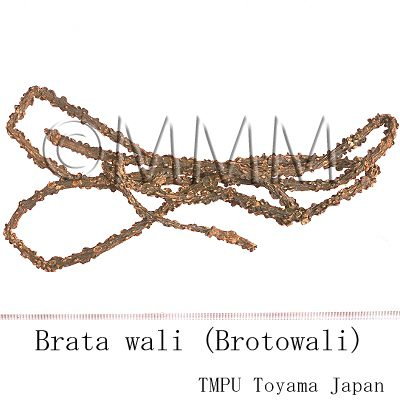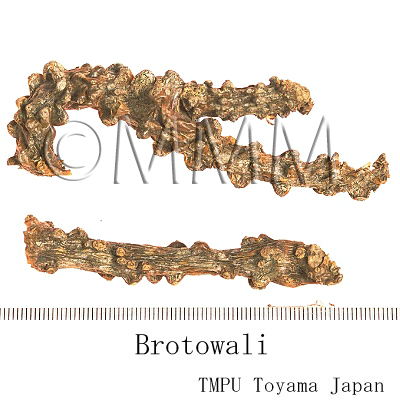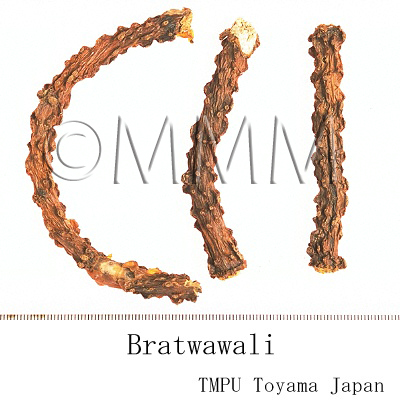

Crude drug sample data base
※Click on the image to enlarge it.
Crude drug name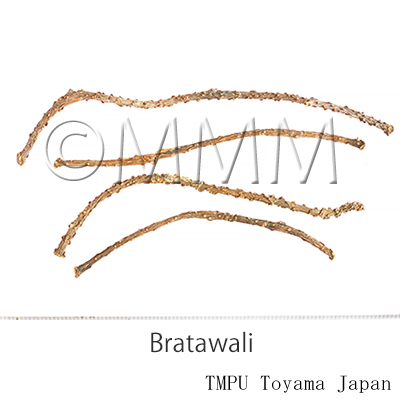 | Market name | Bratawali |
|---|---|---|
| Formal name | Brotowali | |
| Other names | Java: antawali, bratawali, daun gadel, putrowali (Javanese); andawali (Sundanese); Bali: antawali [201, 205] | |
| Original plant name | Tinospora tuberculata Beumee ex K. Heyne | |
| Family name | Menispermaceae | |
| Used part | Classification | Plant origin | Sub classification | stem |
| Collection information | Republic of Indonesia, Special Region of Yogyakarta , Bringharjo Market , Bringharjo Market | |
| Collection date | 1994/02/24 | |
| Collector | Katsuko Komatsu, et al. | |
| TMPW No. | 14115 | |
The capital city, provincial capital city or the representative
location of its administrative area is indicated.
location of its administrative area is indicated.
Production area information
https://ethmed.toyama-wakan.net/img/pin_san.png
-7.7955798
110.36948959999995
Collection information
Republic of Indonesia,Special Region of Yogyakarta
https://ethmed.toyama-wakan.net/img/pin_nyu.png
Scientific information data base
| Crude drug name | Indonesian name, English name | Brotowali | ||||
|---|---|---|---|---|---|---|
| crude drug image |
| |||||
| Original plant name | Tinospora tuberculata Beumee ex K. Heyne | |||||
| Family name | Menispermaceae | |||||
| Used part | Stem | |||||
| Distribution area | It occurs in some islands in Indonesia including Java, Bali, Ambon, Sumbawa [201]. | |||||
| Description | The stem contains an exceedingly bitter milky sap. Stems are tuberculate and producing very long filiform aerial roots. The plant is a woody climber up to 15 m long; leaves broadly ovate to orbicular. Inflorescences appearing when plant is leafless; flowers with 3 petals; fruits ellipsoidal [205]. | |||||
| Drug effect | Bitter, cooling, blood cleanser [231]. | |||||
| Specific actions | Analgesic, stomachic, antipyretic [231]. | |||||
| Frequency in use | Moderate. | |||||
| Pharmacological effect | Berberine and its salts have spasmolytic, antibacterial, antifungal and antiprotozoal activity [205]. Aqueous extract from Tinospora crispa stems showed lowering of blood glucose levels and stimulated insulin release in moderate alloxan-diabetic rats [205]. | |||||
| Medical system | Indonesian medicine (Jamu) | |||||
| Traditional usage | Infusion of the stem which is very bitter is used as a vermifuge and of the whole plant to treat cholera; it is also used to treat diabetes melitus. Starches obtained from stem are sold for treating diabetes. Stems (infusions, decoctions) are effective in the treatment of skin complaints (external as antiseptic, antiparasitic, wounds, itches), stomach complaints (ulcers, as appetizer, tonic), diarrhoea/diarrhea, fever. In treating wounds, bruised leaves are then used to cover the wounds (in patients with syphillis). In a certain place in Central Java, the grated stem is boiled to make a paste, which is sometimes mixed with vegetable oil and sulphur, and is used to treat scabies. The stem is also applied against jaundice [201, 205]. In Bali, the stem is used to treat stomachache, fever, jaundice, as a liniment to treat low back pain [201]. | |||||
| Formulation | 1) Fever: 3 grams of fresh stem of T. tuberculata, 6 grams of fresh leaves of Blumea balsamifera, 4 grams of fresh leaves of Orthosiphon stamineus, 4 grams of fresh rhizome of Alpinia galanga are boiled in 110 ml of water to make a decoction. Drink the decoction 100 ml once a day for 10 days. The ingredients can also be pounded, squeezed, strained to obtain juice. Drink 1/4 cup of the juice a day. The mixture of the ingredients also can be made into pills, which are taken 9 pills three times a day [231]. 2) Itchiness: Fresh stem is cut into pieces and boiled with water to make a decoction. Use the decoction to wash the affected area and dilute the mother liquid with warm water if necessary. Not recommended for pregnant women [231]. 3) Diabetes mellitus: 15 grams of stem of T. tuberculata, 15 grams of dried leaves of Andrographis paniculata, 15 grams of dried leaves of Orthosiphon stamineus, are boiled with 600 ml of water to make 300 cc decoction. Strain and drink the decoction. | |||||
| References | Reference book Tips! | [201] K. Heyne, Tumbuhan Berguna Indonesia, Vols. 1-4, 1987. Diedarkan Oleh Koperasi Karyawan Departemen Kehutanan, Jakarta, Indonesia. Vol. 2, pp 755-756. [205] de Pdua, L.S., Bunyapraphatsara, N. and Lemmens, R.H.M.J. (Editors), 1990. Plant Resources of South-East Asia No. 12 (1). Medicinal and poisonous plants 1. Backhuys Publishers, Leiden, Netherlands. pp 483-484. [231] Soedibyo, Mooryati: Alam Sumber Kesehatan: Manfaat dan Kegunaan (Natural resources for health. Benefits and uses). Balai Pustaka. 1998. pp 92-93. | ||||
| Last renewal date | 2024/02/29 | |||||