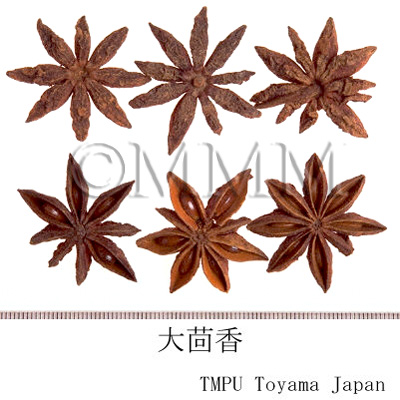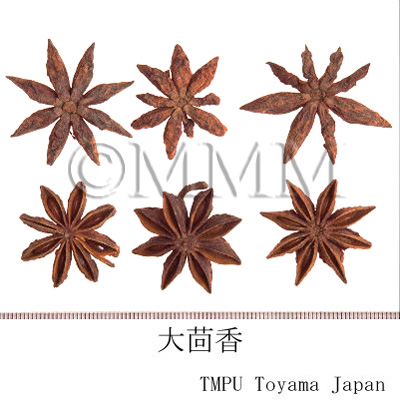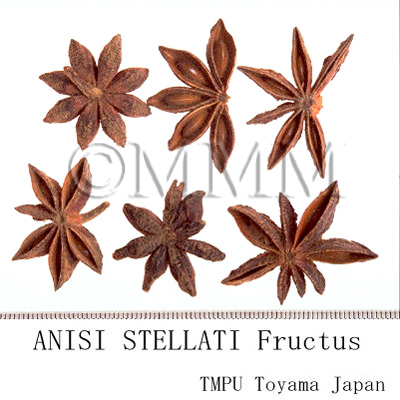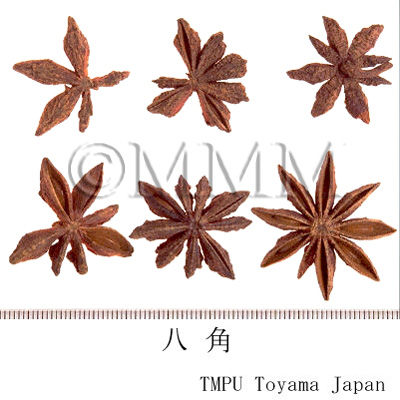

Crude drug sample data base
※Click on the image to enlarge it.
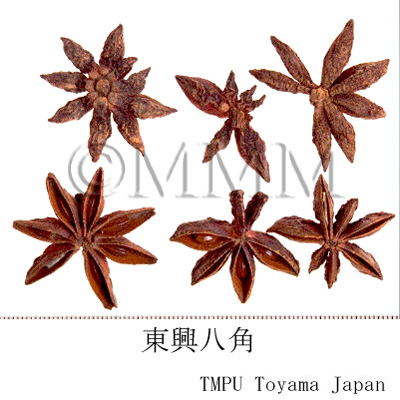
Crude drug name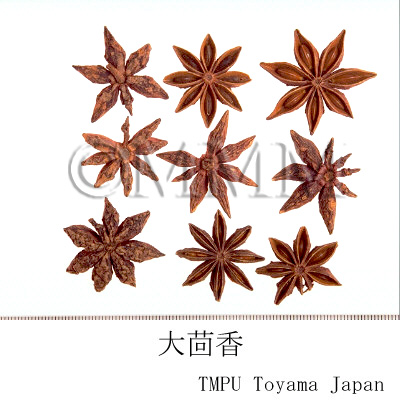 | Market name | 大茴香 |
|---|---|---|
| Formal name | 大茴香 | |
| Japanese name | だいういきょう, Daiuikyō | |
| Vernacular name | Dahuixiang | |
| Latin name | Anisi Stellati Fructus (CP) | |
| English name | Star Anise | |
| Original plant name | Illicium verum Hook. fil. | |
| Family name | Illiciaceae | |
| Used part | Classification | Plant origin | Sub classification | mature fruit |
| Collection information | Japan, Osaka Pref. , Tochimoto Tenkaido Co., Ltd. , Tochimoto Tenkaido Co., Ltd. | |
| Collection date | 1990/02/21 | |
| Collector | Tsuneo Namba | |
| TMPW No. | 16223 | |
The capital city, provincial capital city or the representative
location of its administrative area is indicated.
location of its administrative area is indicated.
Production area information
https://ethmed.toyama-wakan.net/img/pin_san.png
34.6937378
135.50216509999996
Collection information
Japan,Osaka Pref.
https://ethmed.toyama-wakan.net/img/pin_nyu.png
Scientific information data base
| Common name | 大茴香, Dahuixiang, Anisi Stellati FructusCP, Chinese Star AniseCP, Star Anise | |||||
|---|---|---|---|---|---|---|
| Synonyms | 八角茴香, スターアニス | |||||
| crude drug image |
| |||||
| Original plant name | Illicium verum Hook. fil. | |||||
| Family name | Illiciaceae | |||||
| Used part | mature fruit | |||||
| Quality for selection | Larger specimens with a deep reddish-brown color generally exhibit a stronger aroma and higher essential oil content (TN). | |||||
| Official compendium | CP (2025 ed.) | |||||
| Clinical application | It is used as an aromatic stomachic, carminative, and analgesic agent for the treatment of abdominal distension, vomiting, abdominal pain associated with cold exposure, and cold-related dampness disorders such as beriberi. It is also used as a flavoring and deodorizing agent. It is one of the raw materials for star anise oil. | |||||
| Medical system | Traditional Chinese medicine | |||||
| Drug effect in traditional medicine | Traditional classification | Drugs for dispelling internal cold | ||||
| Beneficial effect | [Property and Flavor] Warm; pungent. [Meridian Tropism] Liver, kidney, spleen and stomach meridians. [Actions] To warm yang and dissipate cold, regulate qi to relieve pain. [Indications] Cold abdominal colic and abdominal pain, vomiting caused by stomach cold, stomach duct and abdominal cold pain. | |||||
| Chemical constituent | Fatty acids related compounds (*C1): Dipentene, 脂肪油/fat oil Monoterpenoids (*C1): Pinene, alpha-Phellandrene, beta-Phellandrene, 1,8-Cineol, Limonene Phenylpropanoids (*C1): Anethole(精油(3-3.5%) の85~90%を占める), Safrole, Methyl chavicol Quinones (*C1): Hydroquinone monoethyl ether Phenol carbonate derivatives (*C1): Protocatechuic acid Other aromatic derivatives (*C1): Anisketone, Anisaldehyde (= Anisic aldehyde), Anisic acid | |||||
| Chemical structure |  
※画像をクリックすると、拡大して表示されます。 | |||||
| Pharmacological effect | Antibacterial. | |||||
| DNA sequence | AF163724 | |||||
| Disease | Full stomach, Abdominal pain, Vomitting, Lower back pain | |||||
| Formulation | rarely used in formula | |||||
| Related drugs | Foeniculi Fructus. | |||||
| References | CP: Pharmacopoeia of the People's Republic of China 2025 edi. C1)The Encyclopedia of Wakan-Yaku with Color Pictures Vol. I, pp 189-190. | |||||
| Remarks | - The benefit of Bajiaohuixiang (Jap. name: Daiuikyō) resembles Xiaohuixiang (Jap. name: Shouikyō). However, Daiuikyō has the heat property which warms the organs strongly, dispels cold and relieves pain. - The fruit of Ilicium religiosum Sieb. et Zucc. (Jap. name: Shikimi), produced in Japan, is the congener of Daiuikyō. Though it resembles Daiuikyō closely, it has a toxic component anisatin. Therefore, it must not be mixed with Daiuikyō. | |||||
| Last renewal date | 2026/07/28 | |||||