
Crude drug sample data base
※Click on the image to enlarge it.
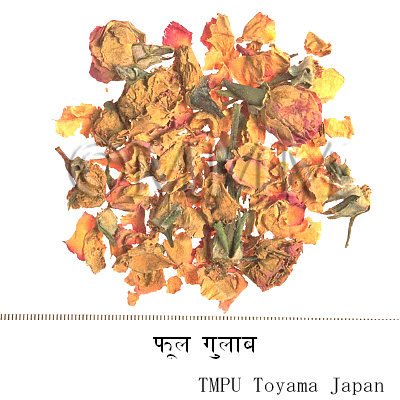
Crude drug name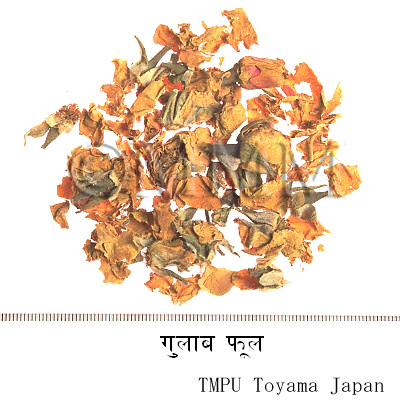 | Market name | Gulab phool |
|---|---|---|
| Formal name | Satapatri | |
Other names Tips! | Golap-phul (B), Gulab-ke-phul (H), Panniru (K), Paninir pushpam (M), Gulabi (Te), Rosa (Ta) | |
| English name | Damask Rose | |
| Original plant name | Rosa damascena Mill., Damask Rose | |
| Family name | Rosaceae | |
| Used part | Classification | Plant origin | Sub classification | flower |
| Production area information | India | |
| Collection information | India, Dibrugarh, Assam , Shree Vishwanath Marwari Databye Aushadhalaya , Shree Vishwanath Marwari Databye Aushadhalaya | |
| Collection date | 1997/05/05 | |
| Collector | Katsuko Komatsu, et al. | |
| TMPW No. | 17329 | |
The capital city, provincial capital city or the representative
location of its administrative area is indicated.
location of its administrative area is indicated.
Production area information
India
https://ethmed.toyama-wakan.net/img/pin_san.png
27.4728327
94.91196209999998
Collection information
India,Dibrugarh, Assam
https://ethmed.toyama-wakan.net/img/pin_nyu.png
Scientific information data base
| Crude drug name | Ayurvedic name or Sanskrit name, English name | Satapatri, Damask Rose | ||
|---|---|---|---|---|
| Synonyms | Mahakumari, Taruni, Satapuspa, Atikesara, Kantakini, Satapatrika, Taruni, Karnika, Carukesara, Gandhadhya, Laksapuspa, Atimanjula, Saumyagandha, Susita, Sumanakhya, Bahukantakini, Svetaraktakusuma, Pusparajni, Saurabheyi, Sandrakirna, Daladhika | |||
| crude drug image |
| |||
| Original plant name | Rosa damascena Mill. | |||
| Family name | Rosaceae | |||
| Used part | Flowers, leaves, root | |||
| Distribution area | Cultivated all over India. | |||
| Remarks | Common. | |||
| Common uses | Flowers are laxative, appetizer and antipyretic and are useful in the treatment of epilepsy. Petals are applied externally as astringent. It is made into a conserve with equal parts of white sugar, known as gulkand. This is used as tonic, mild laxative and is useful in sore throat and enlarged tonsils. Buds are astringent, aperient and good for bile disorders. Stamens are astringent. Rose water, prepared from the petals, is said to have a cooling effect and is also used as a vehicle for medicines. | |||
| Therapeutic uses | Kustha (skin diseases), Mukhasphota (mouth ulcers), Daha (burning), Jvara (fever), Visphota (boils), Raktapitta (bleeding disorders), Pinasa (running nose), Srama (tiredness), Svasakasa (respiratory disorders), Atisveda (excessive sweating), Sirastoda (headache) | |||
| Chemical constituent | - Flowers contain, essential oil; a bitter principle, tannin matter (c.23%), fatty oil and organic acids. They also contain glucosides- quercetin and quercitrin. Flowers also contain juglanin, tribuloside, afzelin, astragalin and trifolin. - Pollen from flowers contain: carotene (0.76mg/100gm) sugars (1.0%) and chlorogenic acid (1.5%). | |||
| Medical system | Ayurveda (Traditional Indian medicine) | |||
| Traditional concept | Rasa (Taste) | Tikta (Bitter), Katu (Pungent), Kasaya (Astringent) | ||
| Virya (Potency) | Sita (Cold) | |||
| Guna (Quality) | Laghu (Light), Snigdha (Unctuous) | |||
| Vipaka (Post digestive taste) | Madhura (Sweet) | |||
| Prabhava (Special action) | Hrdya (good for heart) | |||
| Karma (General action) | Varnya (good for complexion), Pacana (digestive), Rucya (appetising) | |||
| Dosakarma (Action on dosa) | Decreases all three dosas | |||
| Dhatukarma(Action on body tissues) | Sukrala (increasing reproductive tissue), Asra (blood) | |||
| Mala (Action on excretory mechanism) | Grahini (constipative), Vastisodhana (diuretic) | |||
| Avayava (Action on organ) | Hrdya (good for heart), Vasti (bladder), Caksusya (good for eyes) | |||
| Formulation | Gulkhand, Arkagulab | |||
| Related drugs | 1. Rosa centifolia L. | |||
| Comments | According to Nighanturatnakara and Astanga samgraha it is laxative. Sugandhi, Gandhadhya, Saumyagandha refer to smell, Kantakini, Bahukantakini denote thorns of this plant, Satapatrika, Daladhika denote the multipetalous nature, Atikesara denotes the multistamens, Laksapuspa denotes the colour of flower similar to that of lac, Susita denotes cold property. Many people have correlated Rosa centifolia as Satapatrika. But this can be used as a candidate because of similar qualities. | |||
| References | Reference book Tips! | [2] Indian Medicinal Plants - A Compendium of 500 species, Varier, P.S., Orient Longman Ltd. Chennai (Madras) Vol. 5 (Repr.1997), pp 8-12. Glossary of Indian Medicinal Plants, 1956. Chopra, R.N., Nayar, S.L. and Chopra, I.C., Council of Scientific & Industrial Research, New Delhi. - New Edition (1996) National Institute Science Communication; Supplement p 215. Indian Medicinal Plants (Second Edition), Vols. 1-5, 1993. Kirtikar, K.R. and Basu. B.D., Periodical Experts Book Agency, Delhi Vol. 2, p 980. Plants in Ayurveda (A Compendium of Botanical and Sanskrit Names), 1997. Abdul Kareem, M., Foundation for Revitalisation of Local Health Traditions, Bangalore 1403. Dravyagunavijnana, Vols. 1-5, reprint 1998. Sharma, P.V., Chowkhambha Bharati Academy, Varanasi Vol. 2, pp 215-216. | ||
| Last renewal date | 2022/07/07 | |||