
Crude drug sample data base
※Click on the image to enlarge it.
Crude drug name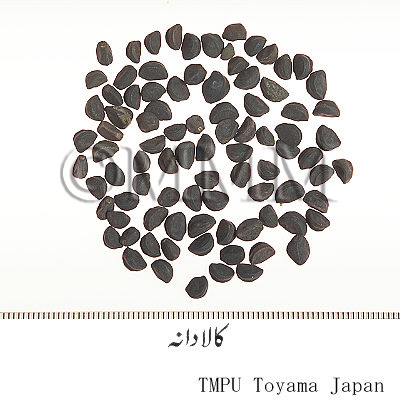 | Market name | Habb-ul-nil |
|---|---|---|
| Urudu name | Kaladana | |
| Arabic name / Persian name | Habb al-nil, Kutm, Halobund / Tukhme-nil, Tukhme-ishqpecha | |
| English name | Pharbitis seeds | |
| Original plant name | Ipomoea nil (L.) Roth. syn. Ipomoea hederacea (L.) Jacq., Pharbitis seeds | |
| Family name | Convolvulaceae | |
| Collection information | Islamic Republic of Pakistan, Karachi [Karachi], Sind , Amjad Unani Medicine (Pvt.)Ltd. , Amjad Unani Medicine (Pvt.)Ltd. | |
| Collection date | 1994/1/22 | |
| Collector | Tsuneo Namba | |
| Identifier | Javed Ahmad | |
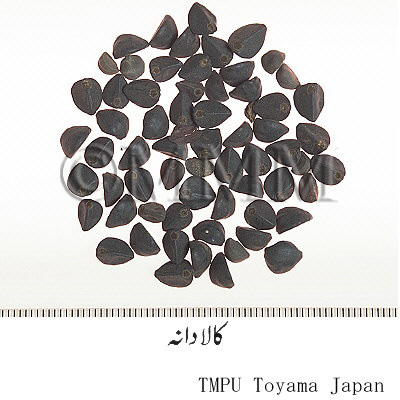
| Description | Features: The colour of the testa is black and glabrous. The seeds resemble in shape with those of most of the convolvuli being in the form of a segment of a sphere. The seeds are three sided and plano-convex in shape. The seeds are 6 to 9mm long and 3 to 4mm. broad. Fracture - hard, difficult to break. Weight of hundred seeds is 6.50gm. Odour - earthy; taste - acrid. | |
| TMPW No. | 15073 | |
The capital city, provincial capital city or the representative
location of its administrative area is indicated.
location of its administrative area is indicated.
Production area information
https://ethmed.toyama-wakan.net/img/pin_san.png
25.0700428
67.2847875
Collection information
Islamic Republic of Pakistan,Karachi [Karachi], Sind
https://ethmed.toyama-wakan.net/img/pin_nyu.png
Scientific information data base
| Crude drug name | Urudu name, English name | Kaladana, Pharbitis seeds | |||
|---|---|---|---|---|---|
| Arabic name / Persian name | Habb al-nil, Kutm, Halobund / Tukhme-nil, Tukhme-ishqpecha | ||||
| crude drug image |
| ||||
| Original plant name | Ipomoea nil (L.) Roth. syn. Ipomoea hederacea (L.) Jacq. | ||||
| Family name | Convolvulaceae | ||||
| Used part | Seeds | ||||
| Distribution area | Throughout India, both cultivated and apparently wild, upto 2,000 meters in the Himalayas. | ||||
| Description | The seeds are blackish in colour and the kernel inside is whitish. Taste - sweetish having bitterness and fastness. | ||||
| Function and properties | Cosmetics, Excretion. Cathartic, anthelmintic, blood purifier, purgative (for excess abnormal humours). Externally attenuant, detersive and resolvent of inflammatory and painful conditions due to malhumours (excess of phlegmatic and atrabilious). | ||||
| Specific actions | Cathartic, diuretic, emmenagogue and externally attenuant, resolvent of inflammatory conditions. | ||||
| Frequency in use | Very common. | ||||
| Common uses | Cosmetics: According to Avicenna (Ibn Sina) it is useful in leucoderma and pityriasis alba. Externally the dried powdered seeds made into paste or ointment applied over leucodermal and vitiliginous patches and over irritative parts of the skin. Excretion: It forcefully expels thick humours, black bile and phlegm. It is purgative and anthelmintic for tapeworms and with the addition of sugar for all conditions of rheumatic pains, dropsy and other atrabilious or cold phlegmatic disorders of chest and abdomen. | ||||
| Side effect | Large doses or continuous use may produce cramps. To avoid this effect, pharbitis seeds are administered with rose flowers or Halela (Terminalia chebula Retz.). It also produces headache and grief or distress. | ||||
| Medical system | Unani | ||||
| Traditional concept | Temperament | Hot and dry in the third degree (Avicenna and Kabiruddin). | |||
| Drug effect | It purifies chest and acts as diuretic and emmenagogue. | ||||
| Dosage | 1 to 3gm. (approximately). | ||||
| Substitute | Tukhm-i-Sudab (Ruta graveolens Linn.), seeds. Half of the quantity of the pulp of colocynth with one sixth of Armenian stone acts as its substitute in cases of diarrhoea/diarrhea and melancholia. | ||||
| Corrigent (corrective) | Almond oil, extract of raisins, figs and citrus fruits. | ||||
| Important compound preparations | Itrifal Deedan, Ma`jun Baladur and Ma`jun Talkh. | ||||
| References | Reference book Tips! | Indian Medicinal Plants (Second Edition), Vols. 1-5, 1993. Kirtikar, K.R. and Basu. B.D., Periodical Experts Book Agency, Delhi Vol. 1, pp 1716-1717. Indian Materia Medica, Vols. 1-2, 1976 (Repr. 1989). Nadkarni, A.K., Popular Prakashan Pvt. Ltd., Bombay Vol. 1, p 688. Makhzanul-Mufradat (Khawasul Adviyah), Hakeem Kabiruddin, Daftar Al-Masih, Qarol Bagh, Delhi. pp 431-432. Dictionary of Economic Plants in India, 1996 (2nd Rep.). Singh, U; Wadhwani, A. M. and Johri B.M. Indian council of Agricultural Research, New Delhi. p 108. Al-Qanun Fil-Tibb. Avicenna. (English translation of the critical Arabic text), Book 2, 1998. Hameed, H. A. (editor), Dept. of Islamic Studies, Jamia Hamdard (Hamdard University), New Delhi. p 158. Hamdard Pharmcopoeia of Eastern medicine, 1969. Said, H. M. (editor), The Times Press, Sadar Karachi. pp 66, 261, 263. Indusyunic Medicine, 1997. Usmanghani, K., Saeed, A. and Alam, M. T. Department of Pharmacognosy, Faculty of Pharmacy, University of Karachi, Karachi. pp 262-263. Unani Adwiyah Mufradah, 1984. Ali, Saifuddin, A. (3rd edi.). Taraqi-e-Urdu Bureau, R. K. Puram, New Delhi. pp 137-138. | |||
| Remarks | This drug is described by all Unani physicians. Itrifal Deedan is a compound formulation of this drug. It is a famous preparation of pharbitis seeds and used as an anthelmintic; all kinds of helminthic worms are expelled out from the body after its administration in proper dosage. The drug is in use since hundreds of years in Unani system of medicine. The drug otherwise is very easily available and have no problem of adulteration. The drug is described as a drastic purgative. As cathartic, the seeds are closely allied to official Jalap, and are used as a substitute. | ||||
| Last renewal date | 2022/06/06 | ||||