

Crude drug sample data base
※Click on the image to enlarge it.
Crude drug name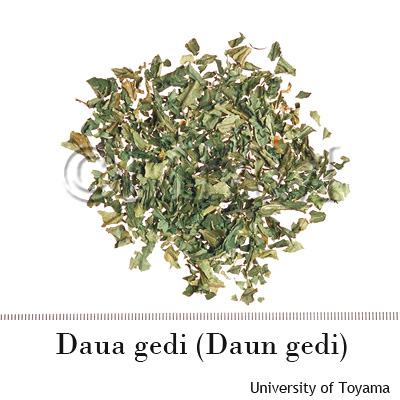 | Market name | Daua gedi (Daun gedi) |
|---|---|---|
| Formal name | Daun gedi | |
| Other names | Celebes: gedi, gidi (Minahasa), diue (Gorontalo); Mollucas: degi (Ternate) [201] | |
| Original plant name | Abelmoschus manihot Medik. syn. Hibiscus manihot Linn. | |
| Family name | Malvaceae | |
| Used part | Classification | Plant origin | Sub classification | leaf |
| Collection information | Republic of Indonesia, West Java Province | |
| Collection date | 1995/--/-- | |
| Collector | Masao Hattori | |
| Identifier | Mangestuti Agil | |
| TMPW No. | 19192 | |
The capital city, provincial capital city or the representative
location of its administrative area is indicated.
location of its administrative area is indicated.
Production area information
https://ethmed.toyama-wakan.net/img/pin_san.png
-6.9174639
107.61912280000001
Collection information
Republic of Indonesia,West Java Province
https://ethmed.toyama-wakan.net/img/pin_nyu.png
Scientific information data base
| Crude drug name | Indonesian name, English name | Daun gedi | ||
|---|---|---|---|---|
| crude drug image |
| |||
| Original plant name | Abelmoschus manihot Medik. syn. Hibiscus manihot Linn. | |||
| Family name | Malvaceae | |||
| Used part | Leaves | |||
| Distribution area | It was introduced from China and cultivated in North and Central Celebes (Indonesia). It is also cultivated in Java [201, 222]. | |||
| Description | Leaves 10-60 cm x 5-60 cm,usually palmate. The plant is a perennial malvaceous shrub, 1.5-7.5 m high, extensively cultivated for its edible leaves. It has a single central stem and short sparse branches, stem hairy. The large, up to 15 cm hibiscus-like flowers are a brilliant lemon with deep purple centres borne on long pedicels at the apex of the plant [222]. | |||
| Frequency in use | Moderate. | |||
| Common uses | It is cultivated for its highly nutritious leaves and shoot tips. The leaves, together with leaves of certain ferns are the most popular vegetable in Minahasa (North Celebes) [201]. | |||
| Pharmacological effect | Study to investigate the ability of Abelmoschus manihot to prevent bone loss in ovariectomised rats gave a result that consumption at the dose of 15% in the diet provided bone-sparing effects by improving bone mineral density and bone mineral content [PMID: 15848020]. The flavone content of Abelmoschus manihot rapidly and reversibly inhibited the NMDA-activated current (I(NMDA) in a concentration-dependent manner and the inhibition of the NMDA receptor response by total flavone of Abelmoschus manihot could be one of the mechanisms for total flavone-mediated neuroprotective actions [PMID: 16616791]. | |||
| Medical system | Indonesian medicine (Jamu) | |||
| References | Reference book Tips! | [201] K. Heyne, Tumbuhan Berguna Indonesia, Vols. 1-4, 1987. Diedarkan Oleh Koperasi Karyawan Departemen Kehutanan, Jakarta, Indonesia. Vol. 3, p 131. [222] P.T. Eisai Indonesia: Medical Herb Index in Indonesia (Second edition).1995. p 82. | ||
| Research paper | 1. Cheng XP, Qin S, Dong LY, Zhou JN. Inhibitory effect of total flavone of Abelmoschus manihot L. Medic on NMDA receptor-mediated current in cultured rat hippocampal neurons. Neurosci Res. 55(2):142-5, 2006. (PMID: 16616791) 2. Puel C, Mathey J, Kati-Coulibaly S, Davicco MJ, Lebecque P, Chanteranne B, Horcajada MN, Coxam V. Preventive effect of Abelmoschus manihot (L.) Medik. on bone loss in the ovariectomised rats. J Ethnopharmacol. 13;99(1):55-60, 2005. (PMID: 15848020) | |||
| Last renewal date | 2022/06/10 | |||