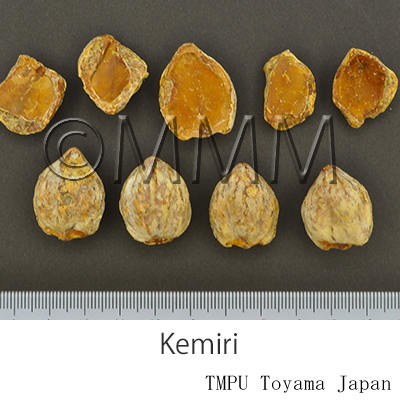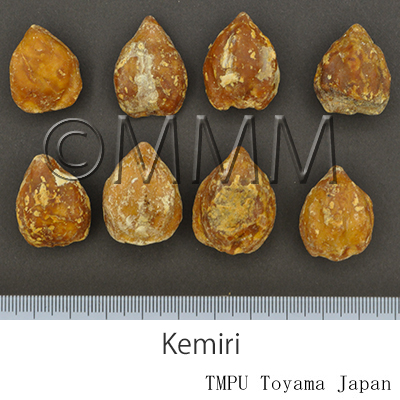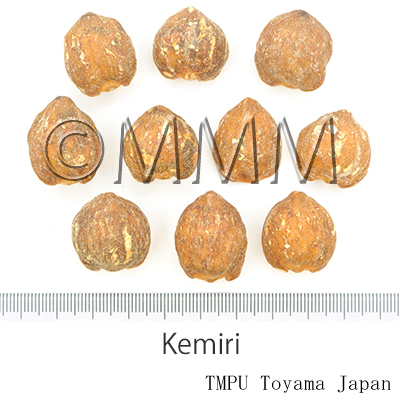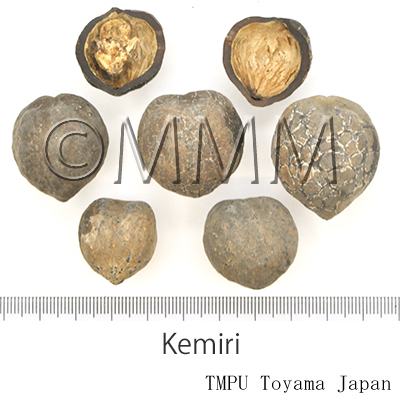

Crude drug sample data base
※Click on the image to enlarge it.
Crude drug name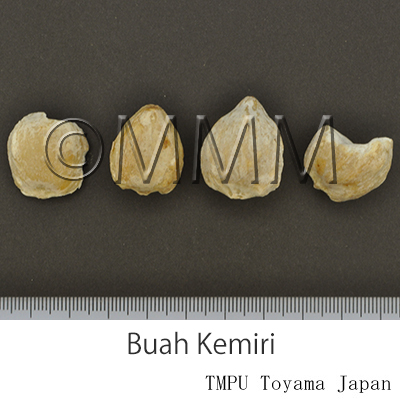 | Market name | Buah Kemiri |
|---|---|---|
| Other names | Java: derekan, pidekan, kemiri, miri (Javanese), muncang (Sundanese), kamere, komere, mere (Madurese); Celebes: sapiri (Makasar), ampiri (Bugis), bintalo dudulaa (Gorontalo); Sumatera: buwah kareh (Minangkabau), kemiling (Lampung); Moluccas: hagi, haget (Buru), saketa (Halmahera) [201] | |
| Original plant name | Aleurites moluccana Willd. | |
| Family name | Euphorbiaceae | |
| Used part | Classification | Plant origin | Sub classification | seed |
| Collection information | Republic of Indonesia, South Sulawesi Province , Somba Opu, Makassar , Somba Opu, Makassar | |
| Collection date | 2004/11/23 | |
| Collector | Others | |
| Identifier | Mangestuti Agil | |
| TMPW No. | 24903 | |
The capital city, provincial capital city or the representative
location of its administrative area is indicated.
location of its administrative area is indicated.
Production area information
https://ethmed.toyama-wakan.net/img/pin_san.png
-5.147665099999999
119.43273139999997
Collection information
Republic of Indonesia,South Sulawesi Province
https://ethmed.toyama-wakan.net/img/pin_nyu.png
Scientific information data base
| Crude drug name | Indonesian name, English name | Kemiri | ||||
|---|---|---|---|---|---|---|
| crude drug image |
| |||||
| Original plant name | Aleurites moluccana Willd. | |||||
| Family name | Euphorbiaceae | |||||
| Used part | Seeds, leaves | |||||
| Distribution area | It is distributed from India and China throughout South East Asia, to Polynesia and New Zealand. It grows wild or cultivated in Java (Indonesia) [201]. It is a commonly planted tree in villages [201, 204]. | |||||
| Description | Fruits are drupaceous, laterally compressed, ovoid-globose. Seed compressed globose, endocarp thick, bony, rough; albumin thick, rich in oil. The plant is a large, monoecious tree. Leaves alternate, simple, base cordate, lobes 3-5 triangular. Inflorescence thyrsoid, terminal or upper axillary. A special cultivar supplies oval thick-walled ''nuts'' called locally ''kemiri pidak'' and ''muncang kelenteng'' [204]. | |||||
| Drug effect | Cooling, slightly toxic, pleasant taste [231]. | |||||
| Specific actions | Seeds: Laxative, stimulant, sudorific [231]. | |||||
| Frequency in use | Abundant | |||||
| Common uses | The seed is an indispensable spice in Indonesian cuisine; it possesses a special flavor and is used either raw or briefly roasted. The fatty seed oil is used in the Indonesian traditional batik industry. For illumination, the oily kernels can be burnt as such, or pounded and made into candles [201, 204]. The residual oil cake is processed into a snack-food called ''dage kemiri''. The oil cake is a good organic fertilizer. The wood is used for furniture, small utensils, matches and is suitable for paper pulp [201, 204]. | |||||
| Side effect | Seeds contain a compound ascribed to a toxalbumin which activity is similar to the toxic compound found in Jatropa curcas. Raw seed is slightly poisonous, acting as a laxative. Symptoms of poisoning was observed after taking seed oil [201, 204]. | |||||
| Pharmacological effect | The lipid-lowering action of the leaves of the Aleurites moluccana methanol extract was mediated through inhibition of hepatic cholesterol biosynthesis and reduction of lipid absorption in the intestine [PMID:12458484]. | |||||
| Medical system | Indonesian medicine (Jamu) | |||||
| Traditional usage | Seed oil is used against hair loss. Eating raw seeds could cause ears to produce liquid material. The seed is used as a laxative, pulped kernels are used in poultices to treat headache, fevers, ulcers, swollen joints and constipation. The bark is used to treat dysentery; the bark sap [mixed with coconut milk) to treat sprue. Decoction of young leaves is good for scrophulosis. Boiled leaves are applied externally to treat headache and gonorrhoea/gonorrhea [201, 204]. | |||||
| Formulation | 1) Frequent bowel movement: 5 seed shells is boiled in 110 ml of water to make a decoction. Drink 100 ml of the decoction once a day for 3 days [231]. | |||||
| References | Reference book Tips! | [201] K. Heyne, Tumbuhan Berguna Indonesia, Vols. 1-4, 1987. Diedarkan Oleh Koperasi Karyawan Departemen Kehutanan, Jakarta, Indonesia. Vol. 2, pp 1174-1177. [204] de Guzman, C.C. and Siemonsma, J.S. (Editors), 1999. Plant Resources of South-East Asia No. 13 Species. Backhuys Publishers, Leiden, Netherlands. pp 63-65. [231] Soedibyo, Mooryati: Alam Sumber Kesehatan: Manfaat dan Kegunaan (Natural resources for health. Benefits and uses). Balai Pustaka. 1998. pp 211-212. | ||||
| Research paper | 1. Girardi LG, Morsch M, Cechinel-Filho V, Meyre-Silva C, Rodrigues CA. Isolation of flavonoids from Aleurites moluccana using chitosan modified with benzaldehyde (CH-Bz) as chromatographic support. Pharmazie, 58(9):629-30, 2003. [PMID: 14531457]. 2. Pedrosa RC, Meyre-Silva C, Cechinel-Filho V, Benassi JC, Oliveira LF, Zancanaro V, Dal Magro J, Yunes RA. Hypolipidaemic activity of methanol extract of Aleurites moluccana. Phytother Res., 16(8):765-8, 2002. (PMID: 12458484) | |||||
| Remarks | DNA sequence: AB441753 | |||||
| Last renewal date | 2024/03/07 | |||||