
Crude drug sample data base
※Click on the image to enlarge it.
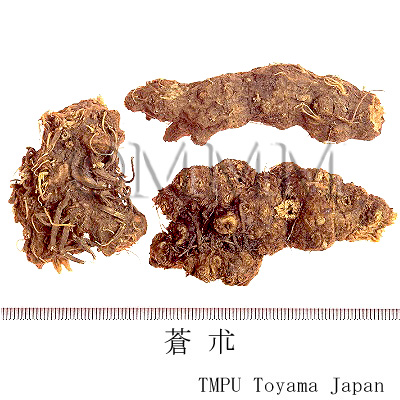
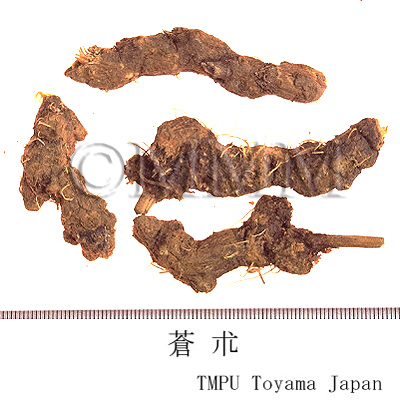
Crude drug name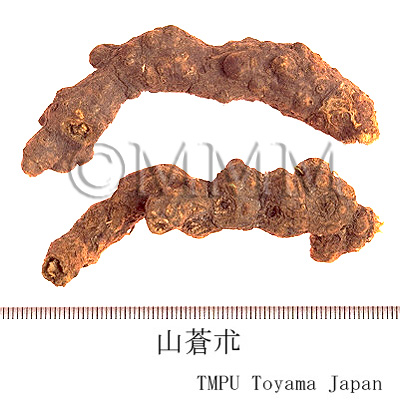 | Market name | 山蒼朮 |
|---|---|---|
| Formal name | 蒼朮 | |
| Japanese name | そうじゅつ, Sōjutsu | |
| Vernacular name | Cangzhu | |
| Latin name | Atractylodis Lanceae Rhizoma (JP), Atractylodis Rhizoma (CP) | |
| English name | Atractylodes Lancea Rhizome (JP), Atractylodes Rhizome (CP) Cangzhu | |
| Original plant name | Atractylodes chinensis Koidzumi, (Shinaokera) | |
| Family name | Compositae | |
| Used part | Classification | Plant origin | Sub classification | rhizome |
| Collection date | 1957/00/00 | |
| TMPW No. | 347 | |
Scientific information data base
| Common name | 蒼朮, Cangzhu, Atractylodis Lanceae RhizomaJP, Atractylodis RhizomaCP, Atractylodes Lancea RhizomeJP, Atractylodes RhizomeCP | |||||
|---|---|---|---|---|---|---|
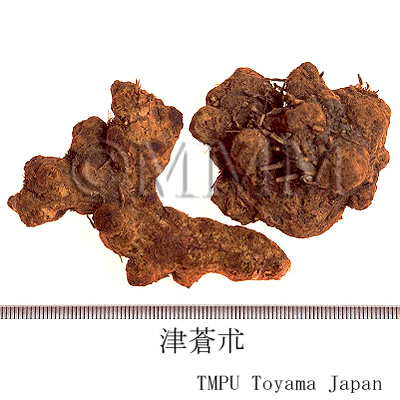
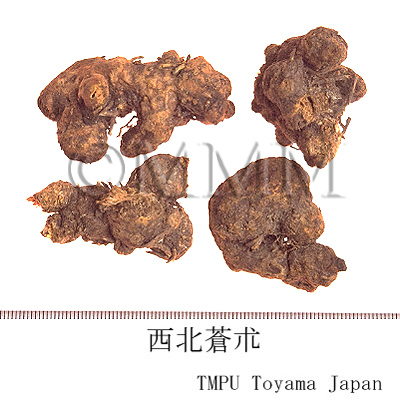
| Synonyms | 茅朮, 津蒼朮, 西北蒼朮, 北鮮蒼朮, 韓蒼朮 | |||||
| crude drug image |
| |||||
| Original plant name | Atractylodes lancea De Candolle1 or Atractylodes chinensis Koidzumi2, (Hosobaokera1 or Shinaokera2) or their interspecific hybrids. | |||||
| original plant image |
| |||||
| Family name | Compositae | |||||
| Used part | rhizome | |||||
| Quality for selection | Those that are well-developed, heavy and dense, and have a strong aroma and taste are considered to be of good quality (TN). | |||||
| Official compendium | JP XIX, CP (2025 ed.) | |||||
| Clinical application | It is used as a diuretic, diaphoretic, stomachic, and intestinal-regulating agent for conditions such as indigestion, diarrhea, and muscular disorders caused by wind-dampness. It is an important remedy for eliminating retained fluids (water-dampness), which refers to impaired fluid metabolism in Kampo medicine. Cangzhu (蒼朮) is considered to have a stronger dampness-drying effect than Baizhu (白朮) and is used for excess patterns characterized by exuberant warmth. | |||||
| Medical system | Traditional Chinese medicine | |||||
| Drug effect in traditional medicine | Traditional classification | Aromatic drugs for resolving dampness | ||||
| Beneficial effect | [Property and Flavor] Warm; pungent and bitter. [Meridian Tropism] Spleen, stomach and liver. [Actions] To dry dampness and fortify the spleen, dispel wind and dissipate cold, and improve vision. [Indications] Dampness obstruction in the middle energizer, distention and fullness in the epigastrium and abdomen, diarrhea, edema, beriberi, leg flaccidity, painful impediment caused by wind-dampness, common cold caused by wind-cold, night blindness, and blurred vision. | |||||
| Chemical constituent | Other aliphatic and related compounds A. lancea (*C1): Atractylodinol, Acetylatractylodinol Sesquiterpenoids A. lancea (*C1): Atractylodin, l-alpha-Bisabolol, beta-Selinene, Atractylone, beta-Eudesmol, Hinesol, Elemol A. lancea, A. chinensis (*C2): Atractylodin, Hinesol, beta-Eudesmol, Elemol, Atractylone, Selina-4(14), 7(11)-dien-8-one | |||||
| Chemical structure |   
※画像をクリックすると、拡大して表示されます。 | |||||
| Pharmacological effect | Antifungal effect; sedative effect (extract, essential oil constituents, beta-eudesmol, hinesol); anticonvulsant effect (extract, beta-eudesmol, hinesol); hypoglycemic effect (alcohol extract). | |||||
| DNA sequence | AB008758, AB008759, AB008760, AB008761, AB008762; Traditioal Medical & Parmaceutical Database. | |||||
| Classical reference (Chinese Herbal Classic "Zhenglei bencao") |  ※Click this image to see the actual image | |||||
| Disease | Dyspepsia, Full stomach, Feeling of pressure in the chest, Nausea, Vomitting, Diarrhea, Swelling and pain of joint, Headache, Anhidrosis, Fever, Chill, Night blindness, Corneal opacity, Cataract | |||||
| Formulation | Ishoho, Ireito, Inchinsan, Eppikajutsuto, Kagen'ireito, Kashokuyohito, Kamishimotsuto, Kamishoyosangoshimotsuto, Kamiheiisan, Kanzobushito, Kufushokutsuto, Keishikajutsubuto, Keishikaryojutsubuto, Keishishakuyakuchimoto, Keishinieppiittokaryojutsubu, Keihito, Koshaheiisan, Goshakusan, Jippito, Shimotsutokakkekagen, Shofusan, Jokinritsuansan, Joshitsuhokito, Jingyobofuto, Jintanto, Shimbuto, Seishitsuketanto, Seijokentsuto, Seineitsugeutsuto, Sokeikakketsuto, Daibofuto, Takushato, Jidabokuippo, Tokishakuyakusanmatsu, Tokinentsuto, Toryuto, Nijutsuto, Hangebyakujutsutemmato, Fukankinshokisanryo, Bushito, Bunshoto, Heiisan, Boiogito, Hokikenchuto, Hojinto, Hochujishitsuto, Yokuininto, Yokukansan, Yokukansankachinpihangeto, Yokukansankachinpihangeto, Rokuutsuto, Kaishun'inchinsan, Koshayoito | |||||
| Related drugs | Baizhu (Atractylodes Rhizome) | |||||
| References | JP: The 19th edition of the Japanese Pharmacopoeia. CP: Pharmacopoeia of the People's Republic of China 2025 edi. C1) The Encyclopedia of Wakan-Yaku with Color Pictures Vol. I, pp 47-50. C2) Nat. Med., 51(6), 499(1997). | |||||
| Remarks | Maozhu (Hancangzhu) is A. lancea (Jap. name: Hosobaokera), produced in Hubei, Jiangxi, Jiangsu Prov. and others. Jincangzhu (Shancangzhu) is A. chinensis (Jap. name: Shinaokera), produced in Hebei, Henan and Jiangxi. North Korean Cangzhu is A. koreana Kitam. (= A. lancea DC.var. simplicifolia Kitam.), Jap. name: Nanman'okera, produced in Jilin, Liaoning, north part of Korean peninsula and Japan. Cangzhu produced in Maoshan of Jiangsu Prov. is very famous for its high quality. Though the cotton-like white separation of the essential oil on the surface is often misjudged as fungus, it is the mixed crystal of beta-Eudesmol and Hinesol, which is a proof of the high quality. Recent report says that A. lancea has three types (Maoshan, Hubei-anhui and Dabeishan) depending on the characteristics of essential oils. A. chinensis also has two types (North and South). Cangzhu originated from A. lancea, A. chinensis and A. koreana contains Atractylodin. They are clearly distinguished from the one originated from A. japonica or A. ovata, which doesn't contain Atractylodin. | |||||
| Last renewal date | 2026/10/09 | |||||