
Crude drug sample data base
※Click on the image to enlarge it.
Crude drug name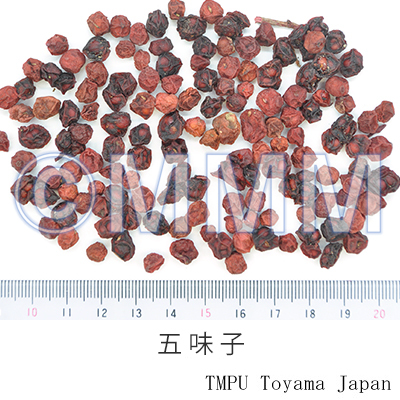 | Market name | 五味子 |
|---|---|---|
| Formal name | 五味子 | |
| Japanese name | ごみし, Gomishi | |
| Vernacular name | Wuweizi | |
| Latin name | Schisandrae Fructus (JP), Schisandrae Chinensis Fructus (CP) | |
| English name | Schisandra Fruit (JP), Chinese Magnoliavine Fruit (CP) | |
| Other names | 北五味子 | |
| Used part | Classification | Plant origin | Sub classification | fruit |
| Production area information | People's Republic of China, Liaoning Prov. | |
| Collection information | Japan(ToS), Osaka Pref. , Tochimoto Tenkaido Co., Ltd. [Non-commercial Sample] , Tochimoto Tenkaido Co., Ltd. [Non-commercial Sample] | |
| Collection date | 2020/12/22 | |
| Collector | Katsuko Komatsu | |
| TMPW No. | 30812 | |
The capital city, provincial capital city or the representative
location of its administrative area is indicated.
location of its administrative area is indicated.
41.805699
123.43147199999999
Production area information
People's Republic of China,Liaoning Prov.
https://ethmed.toyama-wakan.net/img/pin_san.png
34.6937249
135.5022535
Collection information
Japan(ToS),Osaka Pref.
https://ethmed.toyama-wakan.net/img/pin_nyu.png
Scientific information data base
| Common name | 五味子, Wuweizi, Schisandrae Fructus (JP), Schisandrae Chinensis Fructus (CP), Schisandra Fruit (JP), Chinese Magnoliavine Fruit (CP) | ||||||
|---|---|---|---|---|---|---|---|
| Synonyms | 北五味子 Baiwuweizi | ||||||
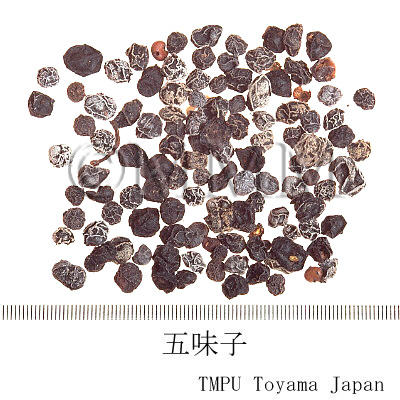
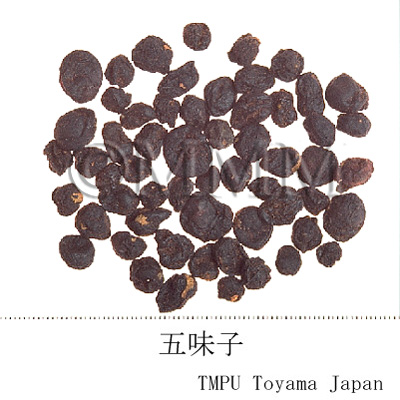
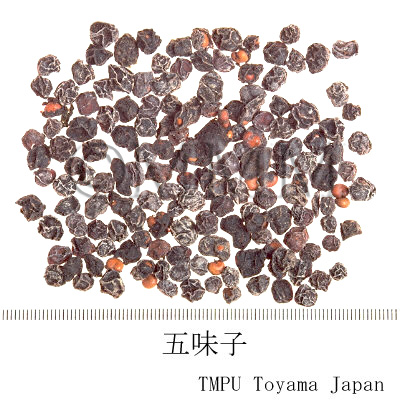
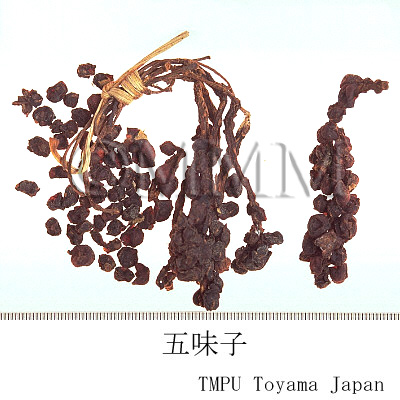
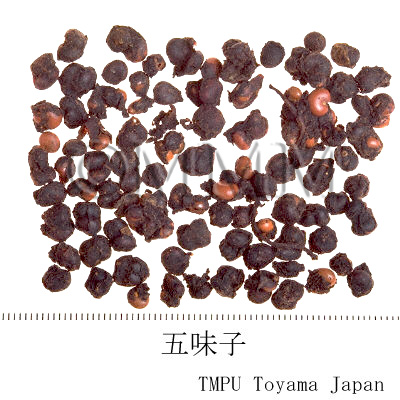
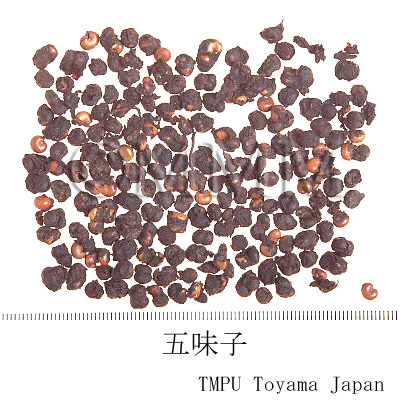
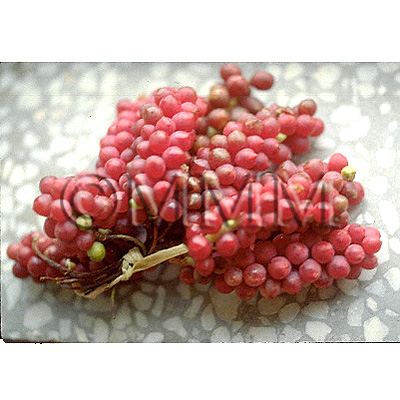
| crude drug image |
| ||||||
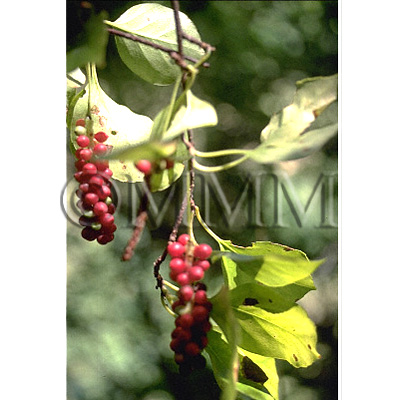
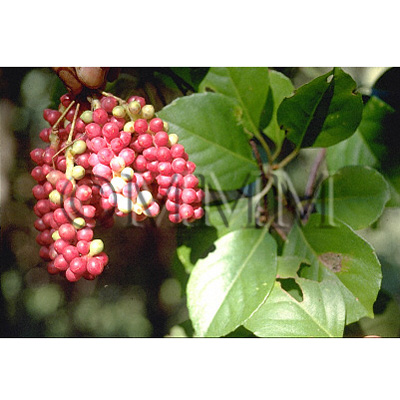
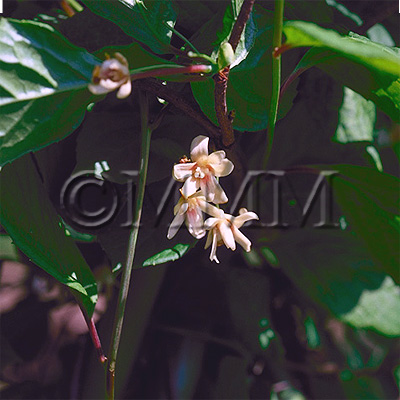
| Original plant name | Schisandra chinensis Baillon, (Chōsengomishi) | ||||||
| original plant image |
| ||||||
| Family name | Schisandraceae | ||||||
| Used part | mature fruit | ||||||
| Quality for selection | Good one has a wrinkled surface, a purplish-black color, and a sweet taste (TN). | ||||||
| Official compendium | JP XIX, CP (2025 ed.) | ||||||
| Clinical application | It is used as an antitussive, astringent, antidiarrheal, nutritive, and tonic agent for conditions accompanied by cough, thirst, persistent diarrhea, sweating, and excessive sputum production. It is also used for liver disorders. | ||||||
| Medical system | Traditional Chinese medicine | ||||||
| Drug effect in traditional medicine | Traditional classification | Astringents and haemostatics | |||||
| Beneficial effect | [Property and Flavor] Warm; sour and sweet. [Meridian Tropism] Lung, heart and kidney meridians. [Actions] To astringe and secure, tonify qi, engender fluid, tonify the kidney and calm the heart. [Indications] Chronic cough, dyspnea of deficiency type, dream emission, spermatorrhea, enuresis, frequent urination, chronic diarrhea, spontaneous sweating, night sweat, thirst caused by fluid consumption, interior heat wasting-thirst, palpitations and insomnia. | ||||||
| Chemical constituent | Other aliphatic and related compounds (*C1): Fumaric acid, Citric acid, Malric acid, Tartaric acid Monoterpenoids (*C1): Citral Sesquiterpenoids (*C1): Sesquicarene, alpha-Ylangene, alpha-Chamigrene, beta-Chamigrene, Chamigrenal Sterols (*C1): beta-Sitosterol Lignans & Neolignans (*C1): Schizandrin (= Schizandrol A), Gomisin A (= Schizandrol B), Gomisin B, Gomisin C, Gomisin D, Gomisin E, Gomisin F, Gomisin G, Schizandrin A (= Deoxyschizandrin), Schizandrin B, Schizandrin C, Schizandrel A, Schizandrel B (*C2): Pregomisin | ||||||
| Chemical structure |      
※画像をクリックすると、拡大して表示されます。 | ||||||
| Pharmacological effect | Suppression of gastric juice secretion,stimulation of bile secretion (schizandrin).sedative・analgesic,decreases body temperature,relaxation of muscles,suppression of stress-induced ulcer (schizandrin, gomisin A).Antitussive (gomisin A).Ataxia,induction of spasm,appearance of arousal brain wave (coal oil-ether extract). | ||||||
| DNA sequence | AF163710, AF094561, AF238061, AF263441, L75842; Traditioal Medical & Parmaceutical Database. | ||||||
| Classical reference (Chinese Herbal Classic "Zhenglei bencao") | 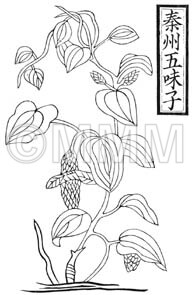 ※Click this image to see the actual image ※Click this image to see the actual image | ||||||
| Disease | Cough, Dyspnea, Spontaneous sweating, Night sweats, Frequent urination, Incontinence of urine, Diarrhea, Thirst, Malaise, Lack of energy, Palpitation | ||||||
| Formulation | Kamishimotsuto, Kyukihochuto, Kyososan, Kobokumaoto, Shionsan, Shoseiryuto, Shoseiryukasekkoto, Shoseiryugomakyokansekito, Shomyakusan, Joshitsuhokito, Seishoekkito, Seinetsuhokito, Seinetsuhoketsuto, Seihaito, Chimobukuryoto, Ninjin-yoei-to, Ninjin-yoei-to, Baimoto, Bakumondoinshi, Fuhishomyakusankabyakukyu, Hohaito, Mibakuekkito, Yakammaoto, Yohaito, Ryokankyomishingeto, Ryokankyomishingeninto, Ryokankyomishingeninoto, Ryokangomikyoshinto | ||||||
| Related drugs | Nanwuweizi (see "Remarks") | ||||||
| References | JP: The 19th edition of the Japanese Pharmacopoeia. CP: Pharmacopoeia of the People's Republic of China 2025 edi. C1)The Encyclopedia of Wakan-Yaku with Color Pictures Vol. I, pp 201-204. | ||||||
| Remarks | In China, the fruits of Schisandra sphenanthera Rehd. et Wils. are referred to as “Nanwuweizi” (South Schisandra Fruit) and are used similarly to the fruits of S. chinensis, known as “Beiwuweizi” (North Schisandra Fruit). Both species are listed as Wuweizi in the Pharmacopoeia of the People's Republic of China. | ||||||
| Last renewal date | 2026/05/12 | ||||||