
Crude drug sample data base
※Click on the image to enlarge it.
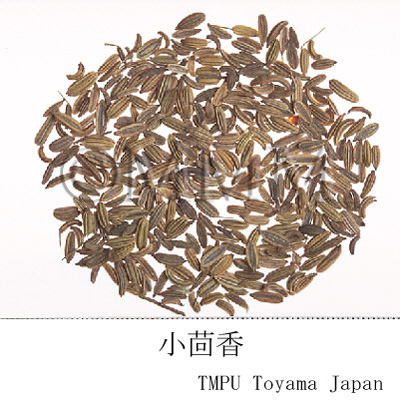
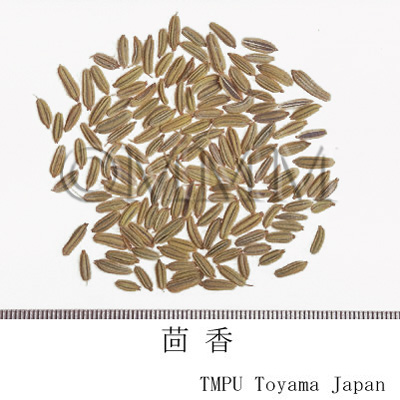
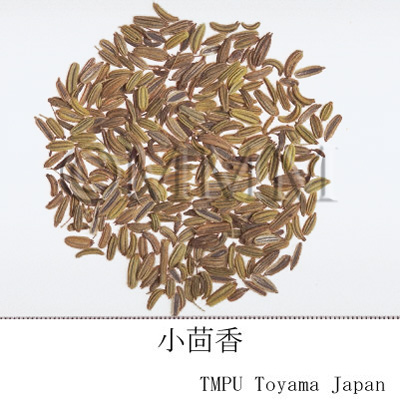
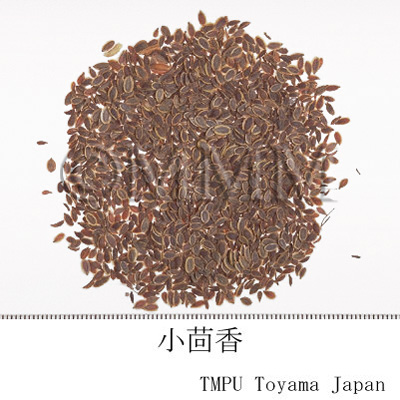
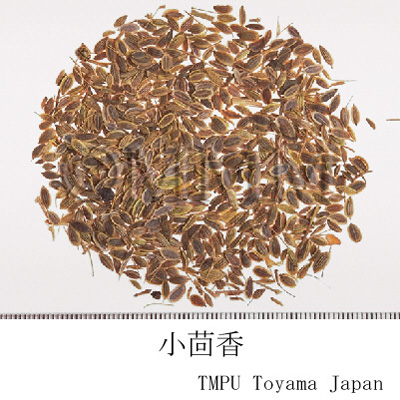
Crude drug name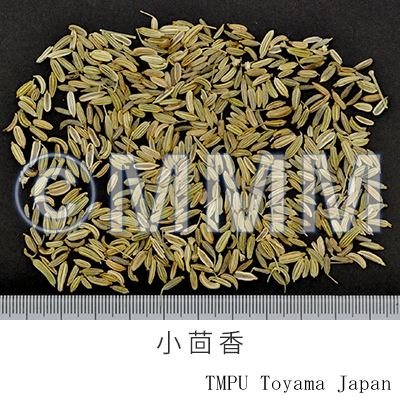 | Market name | 小茴香 |
|---|---|---|
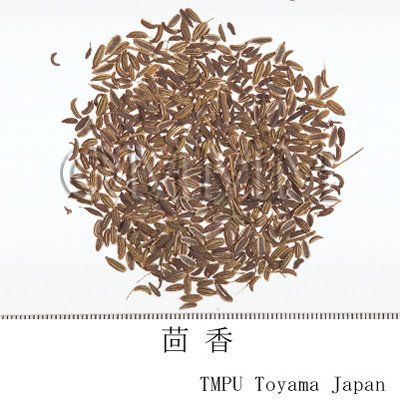
| Formal name | 茴香 | |
| Japanese name | ういきょう, Uikyō | |
| Vernacular name | Xiao huixiang | |
| Latin name | Foeniculi Fructus (JP), (CP) | |
| English name | Fennel (JP), (CP) | |
| Used part | Classification | Plant origin | Sub classification | mature fruit |
| Production area information | People's Republic of China, Gansu Prov. | |
| Collection information | Japan(ToS), Osaka Pref. , Tochimoto Tenkaido Co., Ltd. [Non-commercial Sample] , Tochimoto Tenkaido Co., Ltd. [Non-commercial Sample] | |
| Collection date | 2021/10/11 | |
| Collector | Katsuko Komatsu | |
| TMPW No. | 31329 | |
The capital city, provincial capital city or the representative
location of its administrative area is indicated.
location of its administrative area is indicated.
36.061089
103.83430299999998
Production area information
People's Republic of China,Gansu Prov.
https://ethmed.toyama-wakan.net/img/pin_san.png
34.6937249
135.5022535
Collection information
Japan(ToS),Osaka Pref.
https://ethmed.toyama-wakan.net/img/pin_nyu.png
Scientific information data base
| Common name | 茴香, Huixiang, 小茴香, Xiaohuixiang, Foeniculi Fructus (JP), (CP), Fennel (JP), (CP) | |||||
|---|---|---|---|---|---|---|
| crude drug image |
| |||||
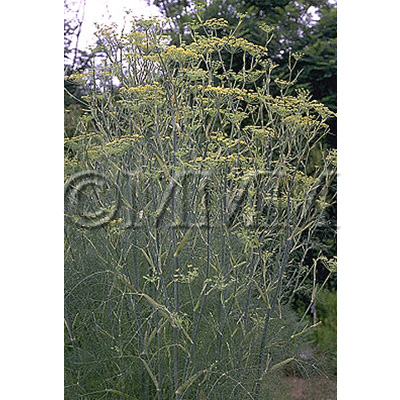
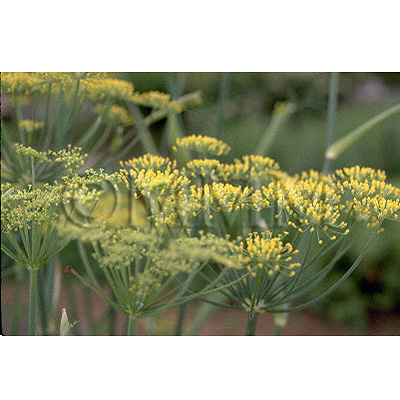
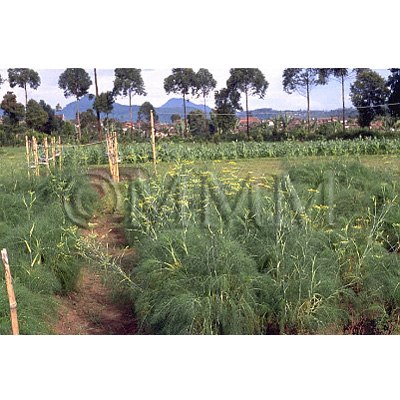
| Original plant name | Foeniculum vulgare Miller, (Uikyō) | |||||
| original plant image |
| |||||
| Family name | Umbelliferae | |||||
| Used part | mature fruit | |||||
| Quality for selection | A good-quality one has a grayish yellow-green to grayish yellow outer surface, a strong aroma, and a slightly sweet taste when chewed. Darkened material is considered inferior. (TN) | |||||
| Official compendium | JP XIX, CP (2025 ed.) | |||||
| Clinical application | Aromatic stomachic, carminative, expectorant and spice. In Chinese traditional medicine, Huixiang is applied, as painkiller, for lower abdominal pain and colic of cold and yin type. | |||||
| Medical system | Traditional Chinese medicine | |||||
| Drug effect in traditional medicine | Traditional classification | Drugs for dispelling internal cold | ||||
| Beneficial effect | [Property and Flavor] Warm; pungent. [Meridian Tropism] Liver, kidney, spleen and stomach meridians. [Actions] To dissipate cold and relieve pain, and regulate qi to harmonize the stomach. [Indications] Abdominal pain caused by cold abdominal colic, hydrocele of the tunica vaginalis, dysmenorrhea, cold pain in the lower abdomen, distending pain in the epigastrium and abdomen, reduced food intake with vomiting and diarrhea. | |||||
| Chemical constituent | Lipids (*C1): 脂肪油/fatty oil Monoterpenoids (*C1): d-Limonene, l-Limonene, d-Fenchone, d-Pinene, Dipentene, beta-Pinene, Camphene, gamma-Terpinene, p-Cymene, Camphor Phenylpropanoids (*C1): Anethole, Estragole Other aromatic derivatives (*C1): Anisaldehyde | |||||
| Chemical structure | 
※画像をクリックすると、拡大して表示されます。 | |||||
| Pharmacological effect | Hyperperistalsis of intestinal tract (Fennel Oil). | |||||
| DNA sequence | AF044586, D44567, U58563, U78385, U78445 | |||||
| Classical reference (Chinese Herbal Classic "Zhenglei bencao") | 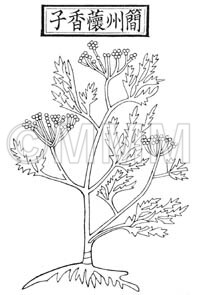 ※Click this image to see the actual image ※Click this image to see the actual image | |||||
| Disease | Coldness of limbs, Lower abdominal pain, Pain of testis, Scrotal hydrocele, Upper abdominal pain, Vomitting, Anorexia | |||||
| Formulation | Anchusan, Kagenshosaikoto, Chokoshiteito, Hointo | |||||
| Related drugs | Illicium verum Hook.f., Star Anise | |||||
| References | JP: The 19th edition of the Japanese Pharmacopoeia. CP: Pharmacopoeia of the People's Republic of China 2025 edi. C1) The Encyclopedia of Wakan-Yaku with Color Pictures Vol. I, pp 209-210. | |||||
| Remarks | Dahuixiang (Jap. name: Daiuikyō) is the fruit of Illicium verum Hook. fil. of family Illiciaceae. On the other hand, the fruit of F. vulgare is called Xiaohuixiang (Jap. name: Kouikyō). | |||||
| Last renewal date | 2026/05/12 | |||||