
Crude drug sample data base
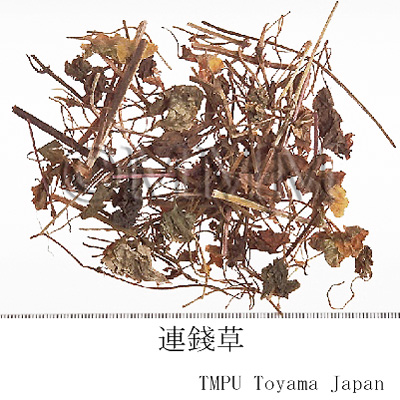
※Click on the image to enlarge it.
Crude drug name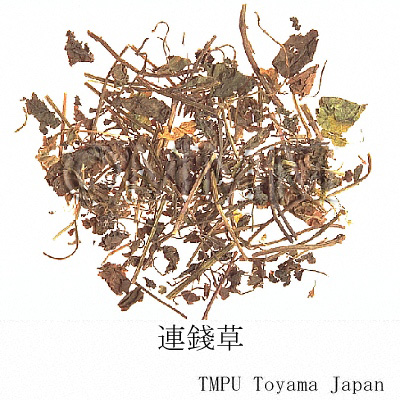 | Market name | 連銭草 |
|---|---|---|
| Formal name | 連銭草 | |
| Japanese name | れんせんそう, Rensensō | |
| Vernacular name | Lianqiancao | |
| Latin name | Glechomae Herba (CP) | |
| English name | Glechoma Herb (CP) | |
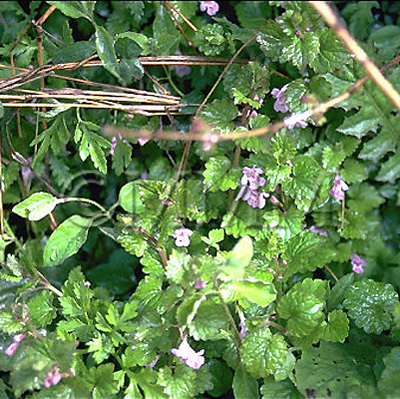
| Original plant name | Glechoma hederacea L. subsp. grandis (A. Gray) Hara, (Kakidōshi) | |
| Family name | Labiatae | |
| Used part | Classification | Plant origin | Sub classification | whole plant |
| Collection information | Japan, Osaka Pref. , Tochimoto Tenkaido Co., Ltd. , Tochimoto Tenkaido Co., Ltd. | |
| Collection date | 1975/02/00 | |
| TMPW No. | 3929 | |
The capital city, provincial capital city or the representative
location of its administrative area is indicated.
location of its administrative area is indicated.
Production area information
https://ethmed.toyama-wakan.net/img/pin_san.png
34.6937378
135.50216509999996
Collection information
Japan,Osaka Pref.
https://ethmed.toyama-wakan.net/img/pin_nyu.png
Scientific information data base
| Common name | 連銭草, Lianqiancao, Glechomae HerbaCP, Longtube Ground Ivy HerbCP | ||||
|---|---|---|---|---|---|
| crude drug image |
| ||||
| Original plant name | Glechoma hederacea L. subsp. grandis (A. Gray) Hara, (Kakidōshi) | ||||
| original plant image |
| ||||
| Family name | Labiatae | ||||
| Used part | whole plant in the flowering season | ||||
| Official compendium | CP (2025 ed.) | ||||
| Clinical application | Used as a tonic for children with weak constitutions. Nagata Tokuhon, a Kampo physician of the Edo period, described that for the treatment of diarrhea, a decoction of Glechoma with Geranium thunbergii and a small amount of licorice, taken warm, was beneficial. It is also used as a tea preparation for diabetes mellitus and nephritis. In China, it is used for hepatitis and urinary tract calculi. | ||||
| Medical system | Traditional Chinese medicine | ||||
| Drug effect in traditional medicine | Traditional classification | Diuretics removing dampness | |||
| Beneficial effect | [Property and Flavor] Mild cold; pungent and mild bitter. [Meridian Tropism] Liver, kidney and bladder meridians. [Actions] To drain dampness and relieve stranguria, clear heat and remove toxin, dissipate stasis and disperse swelling. [Indications]Heat strangury, stone strangury, dampness-heat jaundice, sore, abscess, swelling and pain, injuries from falls and fights. | ||||
| Chemical constituent | Other aliphatic and related compounds (*C1): Palmitic acid, Succinic acid Monoterpenoids (*C1): l-Pinocamphone, l-Menthone, l-Pulegone, alpha-Pinene, beta-Pinene, Limonene, 1,8-Cineole, Isomenthone, Isopinocamphone, Linalool, Menthol, alpha-Terpineol Triterpenoids (*C1): Ursolic acid Sterols (*C1): beta-Sitosterol Amino acids (*C1): Proline, Valine, Tyrosine, Glutamic acid, Aspartic acid Simple nitrogen containing compounds (*C1): Choline Others (*C1): Potassium nitrate, Isopinocavaline | ||||
| Chemical structure |  
※画像をクリックすると、拡大して表示されます。 | ||||
| Pharmacological effect | Enhancement of bile secretion. | ||||
| DNA sequence | L14292 | ||||
| Disease | , Urinary calculus, Gallstone, Jaundice, Pyogenic dermatosis, Snake bite, Burn | ||||
| Formulation | |||||
| Related drugs | Lysimachiae Herba | ||||
| References | CP: Pharmacopoeia of the People's Republic of China 2025 edi. C1)The Encyclopedia of Wakan-Yaku with Color Pictures Vol. II, pp 26-28. | ||||
| Remarks | It is used for the treatment of infantile convulsions (kan) and is also known as Kantorisō in Japan. In China, it is generally referred to as Jinqiancao (金錢草) as well. | ||||
| Last renewal date | 2026/07/22 | ||||