
Crude drug sample data base
※Click on the image to enlarge it.
Crude drug name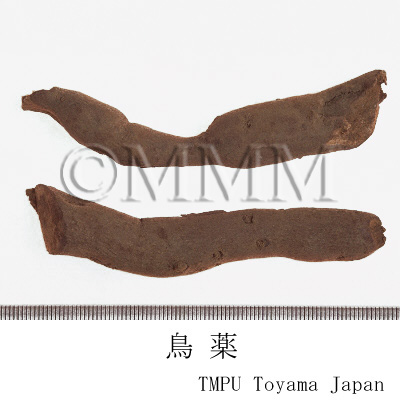 | Market name | 烏薬 |
|---|---|---|
| Formal name | 烏薬 | |
| Japanese name | うやく, Uyaku | |
| Vernacular name | Wuyao | |
| Latin name | Linderae Radix (JP), (CP) | |
| English name | Lindera Root (JP), Combined Spicebush Root (CP) | |
| Original plant name | Lindera strychnifolia (Sieb. et Zucc.) F. Villars, Tendaiuyaku | |
| Family name | Lauraceae | |
| Used part | Classification | Plant origin | Sub classification | root |
| Production area information | People's Republic of China | |
| Collection information | Japan, Osaka Pref. , Tochimoto Tenkaido Co., Ltd. , Tochimoto Tenkaido Co., Ltd. | |
| Collection date | 1957/00/00 | |
| TMPW No. | 504 | |
The capital city, provincial capital city or the representative
location of its administrative area is indicated.
location of its administrative area is indicated.
Production area information
People's Republic of China
https://ethmed.toyama-wakan.net/img/pin_san.png
34.6937378
135.50216509999996
Collection information
Japan,Osaka Pref.
https://ethmed.toyama-wakan.net/img/pin_nyu.png
Scientific information data base
| Common name | 烏薬, Wuyao, Linderae Radix (JP), (CP), Lindera Root (JP), Combined Spicebush Root (CP) | |||||
|---|---|---|---|---|---|---|
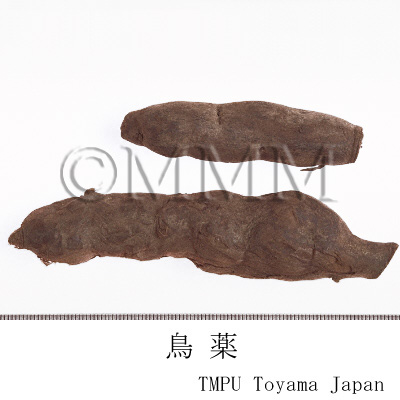
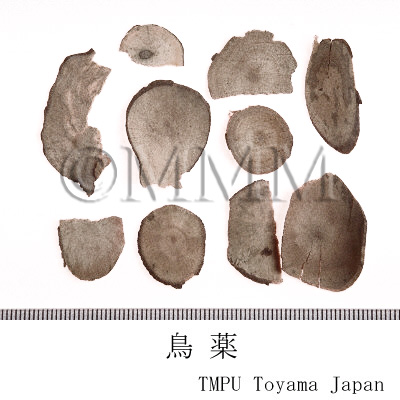
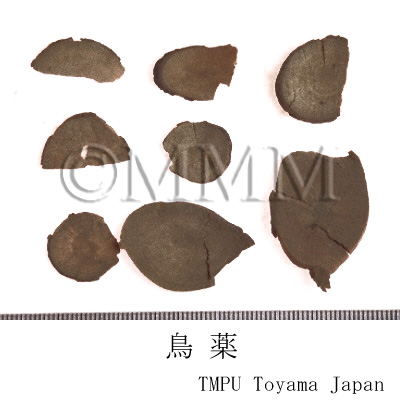
| crude drug image |
| |||||
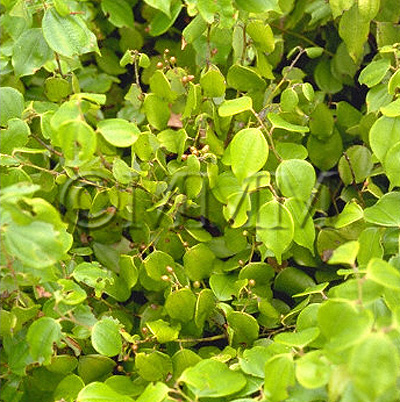
| Original plant name | Lindera strychnifolia Fernandez-Villar, (Tendaiuyaku) | |||||
| original plant image |
| |||||
| Family name | Lauraceae | |||||
| Used part | root (tuberous root) | |||||
| Quality for selection | Those with pointed ends, a swollen middle portion, a reddish-brown exterior, and a white interior are called the "kur type" or "imo type" and are regarded as superior in quality. (NI) | |||||
| Official compendium | JHMC (1989), JP XIX, CP (2025 ed.) | |||||
| Clinical application | As an aromatic stomachic, antispasmodic, painkiller and tonic, Wuyao is applied for distending pain in the chest and abdomen, abdominal pain of cold type, indigestion and frequent urination due to cold of urinary bladder. | |||||
| Medical system | Traditional Chinese medicine | |||||
| Drug effect in traditional medicine | Traditional classification | Carminatives for regulating flow of Qi | ||||
| Beneficial effect | [Property and Flavor] Warm; pungent. [Meridian Tropism] Lung, spleen, kidney and bladder meridians. [Actions] To move qi, relieve pain, warm the kidney, and dissipate cold. [Indications] Qi stagnation caused by congealing cold, distention and pain in the chest and the abdomen, qi counterflow, wheezing, deficient cold in bladder, enuresis and frequent urination, pain caused by genital disease, abdominal pain caused by cold meridians. | |||||
| Chemical constituent | Other aliphatic and related compounds (*C1): Linderic acid Terpenoids (Essential oils) (*C1,C2): Linderene, Isolinderene, Linderane, Lindenenone, Chamazulene, Linderazulene, Lindestrene, Isogermafurene, l-Borneol Alkaloids (*C2): Laurolitsine | |||||
| Chemical structure |   
※画像をクリックすると、拡大して表示されます。 | |||||
| Pharmacological effect | Hyperperistalsis of intestinal tract. | |||||
| DNA sequence | AJ247169 | |||||
| Classical reference (Chinese Herbal Classic "Zhenglei bencao") | 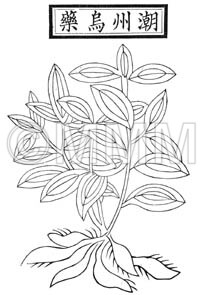 ※Click this image to see the actual image ※Click this image to see the actual image | |||||
| Disease | Pain due to abdominal coldness, Hernia, Dyspnea, Rapid breathing, Full stomach, Menorrhalgia, Frequent urination, Bed-wetting | |||||
| Formulation | Uyakujunkisan, Ureitsukito, Kyukichoketsuin, Kokikososan, Jurokumiryukiin, Shokitenkoto, Tokishusan, Hachimisenkiho, Mokutsusan | |||||
| References | JP: The 19th edition of the Japanese Pharmacopoeia. CP: Pharmacopoeia of the People's Republic of China 2025 edi. C1)The Encyclopedia of Wakan-Yaku with Color Pictures Vol. I, pp 127-128. C2)Outline of Pharmacognosy, a Textbook, p 309. | |||||
| Remarks | Tendaiuyaku is native to China, and according to legend, it was brought to the Nanki region of Japan by Xu Fu during the Qin dynasty. It has since become naturalized in warm regions of Japan. | |||||
| Last renewal date | 2026/05/12 | |||||