
Crude drug sample data base
※Click on the image to enlarge it.
Crude drug name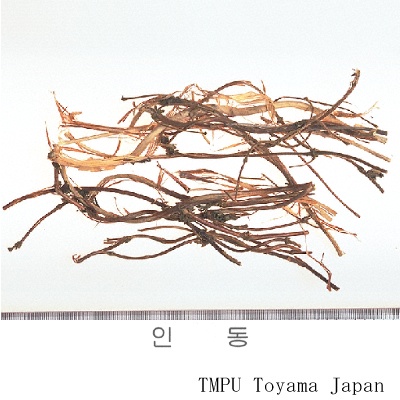 | Market name | 認冬 |
|---|---|---|
| Formal name | 忍冬 | |
| Japanese name | にんどう, Nindō | |
| Vernacular name | Indong | |
| Latin name | Lonicerae Folium cum Caulis (JP), Lonicerae Japonicae Caulis (CP) | |
| English name | Lonicera Leaf and Stem (JP), Honeysuckle Stem (CP) | |
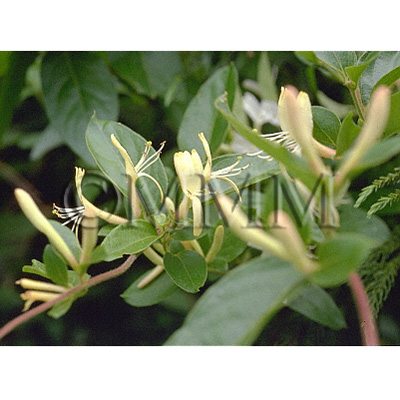
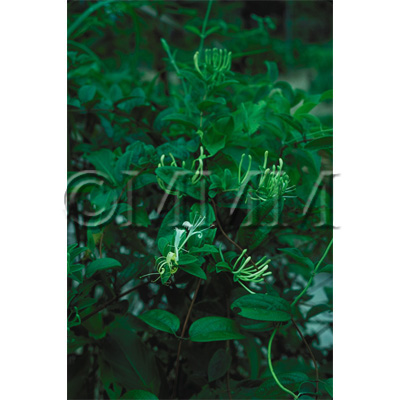
| Original plant name | Lonicera japonica Thunb., (Suikazura) | |
| Family name | Caprifoliaceae | |
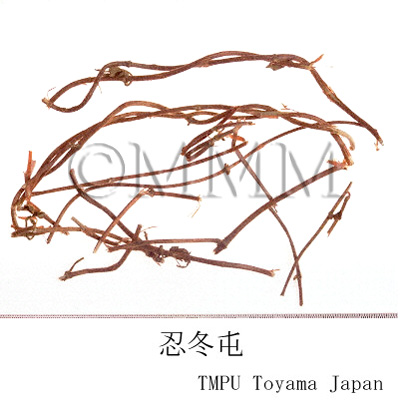
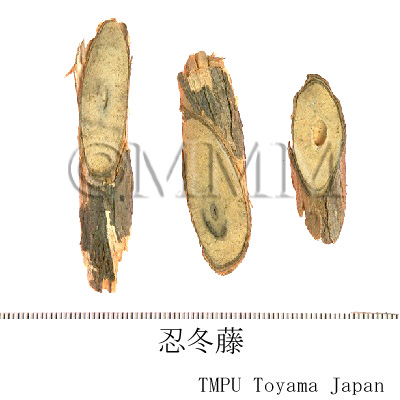
| Used part | Classification | Plant origin | Sub classification | stem |
| Collection information | Republic of Korea, Pusan , Oshige , Oshige | |
| Collection date | 1982/04/00 | |
| Collector | Tsuneo Namba | |
| TMPW No. | 5145 | |
The capital city, provincial capital city or the representative
location of its administrative area is indicated.
location of its administrative area is indicated.
Production area information
https://ethmed.toyama-wakan.net/img/pin_san.png
35.1795543
129.07564160000004
Collection information
Republic of Korea,Pusan
https://ethmed.toyama-wakan.net/img/pin_nyu.png
Scientific information data base
| Common name | 忍冬, Rendong, Lonicerae Folium cum Caulis (JP), Lonicerae Japonicae Caulis (CP), Lonicera Leaf and Stem (JP), Japanese Honeysuckle Flower (CP) | |||||
|---|---|---|---|---|---|---|
| Synonyms | 忍冬藤, 金銀藤, 銀花藤 | |||||
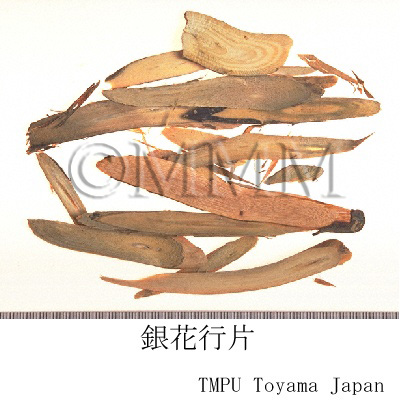
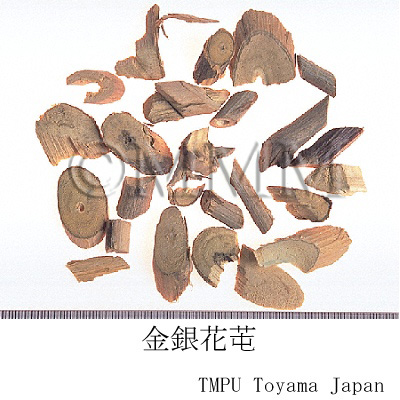
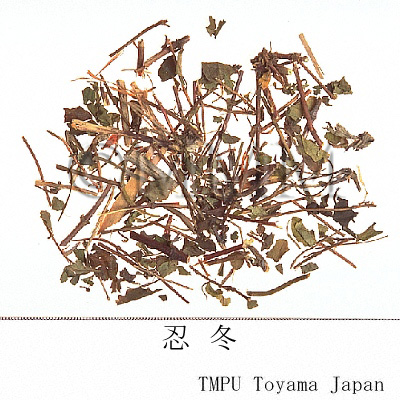
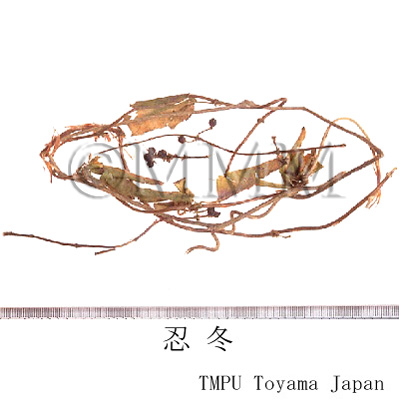
| crude drug image |
| |||||
| Original plant name | Lonicera japonica Thunberg, (Suikazura) | |||||
| original plant image |
| |||||
| Family name | Caprifoliaceae | |||||
| Used part | stem or stem with leaves | |||||
| Quality for selection | Fresh material with a vivid green color is considered to be of high quality (NI). Material marketed as "Yinhua Teng" from Jiangsu Province is regarded as the highest quality. (TN) | |||||
| Official compendium | JHMC (1989), JP XIX, CP (2025 ed.) | |||||
| Clinical application | It is used in folk medicine as an antipyretic, detoxifying, diuretic, and anti-inflammatory agent for the treatment of boils, hemorrhoids, gonorrhea, dysuria, and mushroom poisoning. A concentrated decoction may also be applied externally to boils and hemorrhoids. It is also used for musculoskeletal pain. | |||||
| Medical system | Traditional Chinese medicine | |||||
| Drug effect in traditional medicine | Traditional classification | Febrifugal and detoxicant drugs | ||||
| Beneficial effect | [Property and Flavor] Cold; sweet. [Meridian Tropism] Lung and stomach meridians. [Actions] To clear heat and remove toxin, disperse wind and unblock the collaterals. [Indications] Warm disease with fever, heat-toxin blood dysentery, swelling abscess, , sore and ulcer, wind-dampness heat impediment, red, swelling, heat and painful joint. | |||||
| Chemical constituent | Flavones & Flavonols (*C1): Lonicerin (= Luteolinrhamnoglucoside) Tannins (*C1): タンニン | |||||
| Pharmacological effect | Increase in blood sugar. | |||||
| DNA sequence | AF207727,AF207728,AF207729,AF207730,AF207731,AF207732,AF207733,AF207734 | |||||
| Classical reference (Chinese Herbal Classic "Zhenglei bencao") | 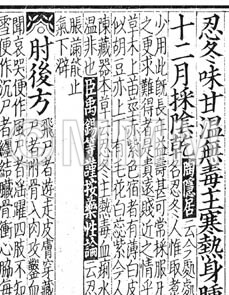 ※Click this image to see the actual image ※Click this image to see the actual image | |||||
| Disease | Pyogenic dermatosis, Swelling and pain of the throat, Diarrhea, Hematochezia, Fever, Rash, Chill, Swelling and pain of joint | |||||
| Formulation | Jizusoippo, Kagawagedokuzai, Shikonboreito, Katsuketsugedokuto, Shogedokuto | |||||
| Related drugs | Lonicera Flower | |||||
| References | JP: The 19th edition of the Japanese Pharmacopoeia. CP: Pharmacopoeia of the People's Republic of China 2025 edi. C1) The Encyclopedia of Wakan-Yaku with Color Pictures Vol. II, pp 172-173. | |||||
| Remarks | In China, Rendong is generally called Jinyinteng (Jap. name: Kingintō) and the infant branch with leaves is called Jinhuateng (Jap. name: Ginkatō). In Japan, it is sold under the name of Nindō, which has less effect in removing toxic heat than Jinyinhua (Jap. name: Kinginka) but stronger effect in expelling wind and promoting flow of meridians. It is widely used as folk medicine as well. | |||||
| Last renewal date | 2026/07/07 | |||||