
Crude drug sample data base
※Click on the image to enlarge it.
Crude drug name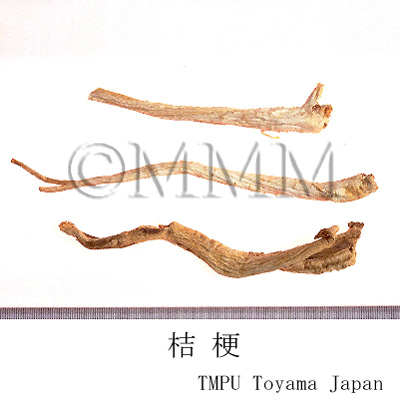 | Market name | 桔梗 |
|---|---|---|
| Formal name | 桔梗 | |
| Japanese name | ききょう, Kikyō | |
| Vernacular name | Jiegeng | |
| Latin name | Platycodi Radix (JP), Platycodonis Radix (CP) | |
| English name | Platycodon Root (JP), (CP) | |
| Original plant name | Platycodon grandiflorum (Jacquin) A. DC., (Kikyō), Platycodon | |
| Family name | Campanulaceae | |
| Used part | Classification | Plant origin | Sub classification | root |
| TMPW No. | 57 | |
Scientific information data base
| Common name | 桔梗, Jiegeng, Platycodi RadixJP, Platycodonis RadixCP, Platycodon RootJP,CP | |||||
|---|---|---|---|---|---|---|
| Synonyms | 晒桔梗 | |||||
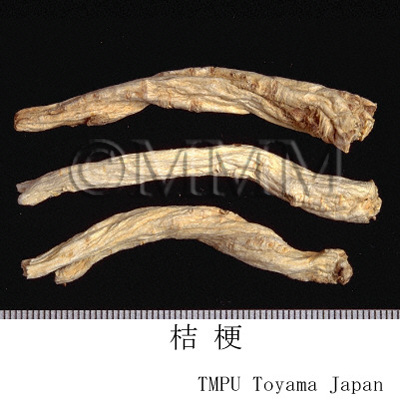
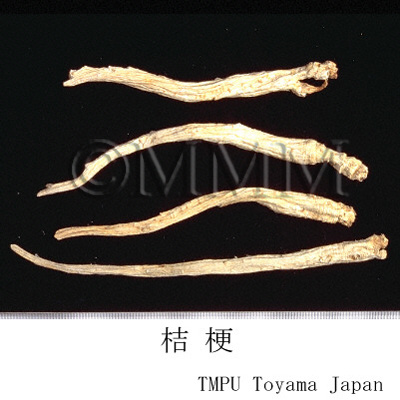
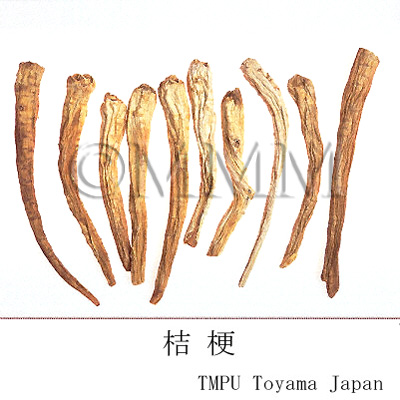
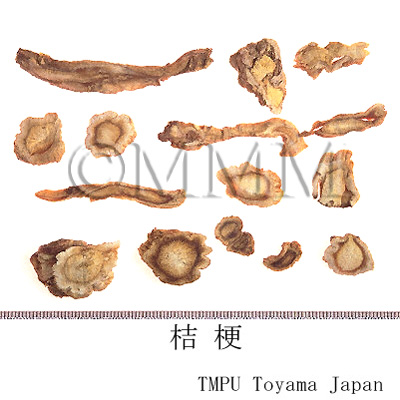
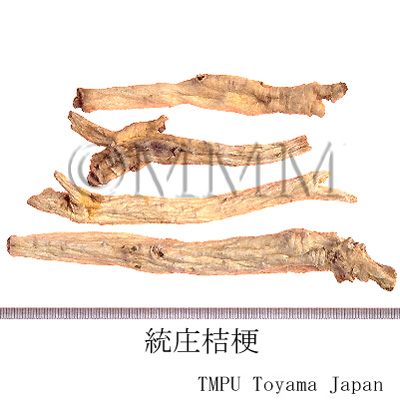
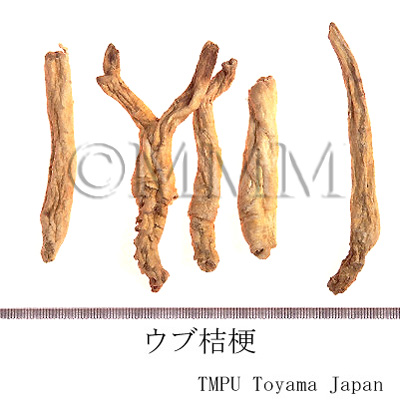
| crude drug image |
| |||||
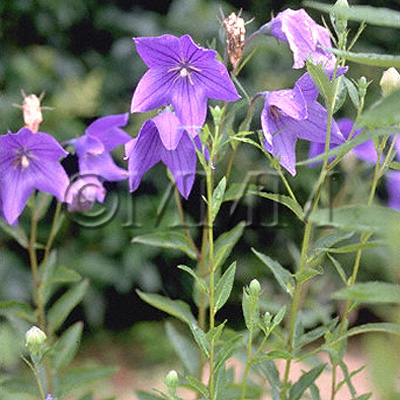
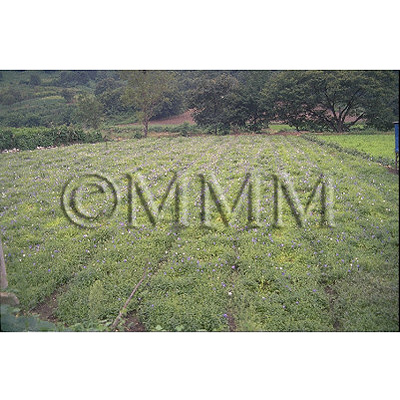
| Original plant name | Platycodon grandiflorus A. De Candolle, (Kikyō) | |||||
| original plant image |
| |||||
| Family name | Campanulaceae | |||||
| Used part | root with or without cork bark | |||||
| Quality for selection | Those with few branches and a white interior are considered to be of good quality (TN). | |||||
| Official compendium | JP XIX, CP (2025 ed.) | |||||
| Clinical application | Used as an expectorant and antitussive for the treatment of cough, bronchitis, and other respiratory conditions. It is also used as an agent to promote pus drainage in suppurative conditions, tonsillitis, sore throat, and other related disorders. | |||||
| Medical system | Traditional Chinese medicine | |||||
| Drug effect in traditional medicine | Traditional classification | Expectorants | ||||
| Beneficial effect | [Property and Flavor] Neutral; bitter and pungent. [Meridian Tropism] Lung meridian. [Actions] To diffuse the lung, soothe the throat, dispel phlegm, expel pus. [Indications] Cough and profuse sputum, oppression and discomfort in the chest, sore throat and hoarseness, lung abscess with pyemesis. | |||||
| Chemical constituent | Polysaccharides (*C1): Inulin, Platycodinin Triterpenoids (*C1): Polygalacic acid, Platycodigenin, Platycogenic acid A, Platycogenic acid B, Platycogenic acid C, Platycodogenin Triterpenoid saponins (*C1): Platycodin A, Platycodin C, Platycodin D, Platycodin D2, Polygalacin D, Polygalacin D2 Sterols (*C1): alpha-Spinasterol, delta7-Stigmasterol, alpha-Spinasteryl-beta-D-glucoside, Betulin | |||||
| Chemical structure |      
※画像をクリックすると、拡大して表示されます。 | |||||
| Pharmacological effect | Promotes tracheobronchial secretions and salivary secretion. Exhibits sedative, analgesic, expectorant, anti-inflammatory, and antiallergic activities. Inhibits gastric acid secretion and exhibits anti-ulcer and peripheral vasodilatory effects. | |||||
| DNA sequence | AF134863; Traditioal Medical & Parmaceutical Database. | |||||
| Classical reference (Chinese Herbal Classic "Zhenglei bencao") | 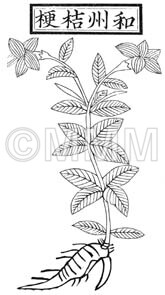 ※Click this image to see the actual image | |||||
| Disease | Cough, Impossible to expectorate sputum, Bronchitis, Pneumonia, Swelling and pain of the throat, Common cold, Nasal obstruction, Pituita, Hoarseness, Tonsillitis, Lung suppurations, Pyogenic dermatosis | |||||
| Formulation | En'nenhangeto, Kakkoshokisan, Kikyoto, Kyoseihatekigan, Keigairengyoto, Kyososan, Goshakusan, Saikoseikansan, Jumihaidokuto, Jinsoin, Jinryobyakujutsusan, Seijobofuto, Seihaito, Chikujountanto, Hainoto, Bofutsushosan, Keimeisankabukuryo, Uyakujunkisan, Kagenryokakusan, Kairosan, Keigairengyoto, Keishigomotsuto, Jijinmeimokuto (Jinkimeimouto), Jurokumiryukiin, Senkanmeimokuto, Hainosankyuto, Byakugokokinto, Ryokakusan, Ikeigoshijunto, Ogibekkoto, Orenshodokuin, Kagenshahakusan, Kagenryokakusan'ippo, Kikyogedokuto, Kikyohakusan, Kippihangeto, Keishigomotsuto, Keimeisan, Shionsan, Shijunto, Shosaikotokakikyosekko, Jinkimeimokuto, Seiishakato, Seiinrikakuto, Seiryoin, Chikuyoto, Chimobukuryoto, Tonsonto, Naisoorento, Naitaku-san, Naitaku-san, Ninjin-yoei-to, Haikanpo, Haidokuto, Hainoto, Haiyoto, Hontonto, Meiganippo, Yohaito, Rengyoto, Platycodon Fluidextract, , | |||||
| Related drugs | Seidei (薺尼): the root of Adenophora remotiflora (Sieb. et Zucc.) Miq. or A. tracheloides Maxim., Shashen (沙参, Adenophorae Radix) and Dangshen (党参, Codonopsis Radix) | |||||
| References | JP: The 19th edition of the Japanese Pharmacopoeia. CP: Pharmacopoeia of the People's Republic of China 2025 edi. C1) The Encyclopedia of Wakan-Yaku with Color Pictures Vol. I, pp 125-127. | |||||
| Remarks | Kawatsukikikyō (Jap. name) is the half-dried product, which has brown bark. Sarashikikyō (Jap. name) is the dried product after being soaked in water. Seidei (Jap. name) is the root of Adenophora remotiflora (Sieb. et Zucc.) Miq., Sobana (Jap. name) of Campanulaceae or A. tracheloides Maxim. Jiegeng has been used for reducing fever, expelling phlegm and as a detoxicant. The roots of Jiegeng, Seidei, Shashen and Renshen resemble each other, which caused confusion in the past. At present, Seidei has no marketability. | |||||
| Last renewal date | 2026/11/06 | |||||