
Crude drug sample data base
※Click on the image to enlarge it.
Crude drug name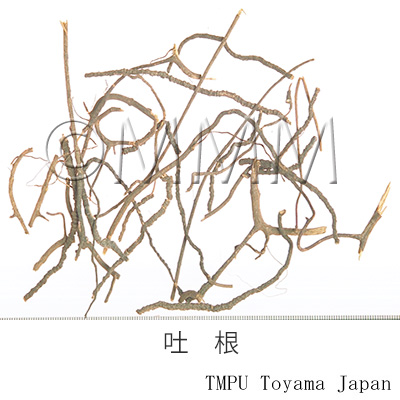 | Market name | 吐根 |
|---|---|---|
| Formal name | 吐根 | |
| Japanese name | とこん, Tokon | |
| Vernacular name | Poaia, Ipeca | |
| Latin name | Ipecacuanhae Radix (JP) | |
| English name | Ipecac (JP) | |
| Original plant name | Cephaelis ipecacuanha A. Rich | |
| Family name | Rubiaceae | |
| Used part | Classification | Plant origin | Sub classification | root |
| TMPW No. | 7517 | |
Scientific information data base
| Common name | 吐根, Poaia, Ipeca, Ipecacuanhae Radix (JP), Ipecac (JP) | |||
|---|---|---|---|---|
| Original plant name | Cephaelis ipecacuanha A. Richard or Cephaelis acuminata Karsten | |||
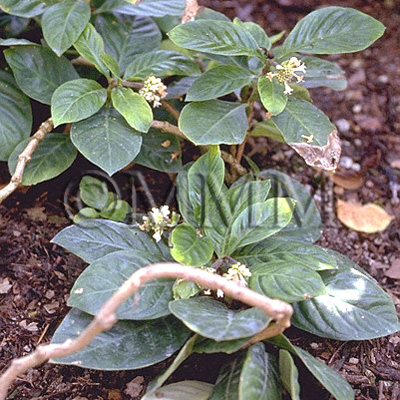
| original plant image |
| |||
| Family name | Rubiaceae | |||
| Used part | root and rhizome | |||
| Official compendium | JP XIX | |||
| Clinical application | It is an emetic and expectorant, and is used as an anti-amoebic agent for the treatment of amoebic dysentery. | |||
| Medical system | Folk medicine | |||
| Chemical constituent | Alkaloids (*C1): Emetine, Cephaeline, Psychotrine, O-Methylpsychotrine, Ipecamine, Hydroipecamine, Emetamine, Protoemetine, Ipecoside, Neoipecoside | |||
| Chemical structure | 
※画像をクリックすると、拡大して表示されます。 | |||
| Pharmacological effect | Expectorant, nauseant (lpecac alkaloid), antibacterial (emetine: amebic dysentery, trophozoite ameba). | |||
| Disease | Expectoration of sputum, Nauseant, Amebic dysentery | |||
| Formulation | ||||
| Related drugs | Cartagenatokon | |||
| References | JP: The 19th edition of the Japanese Pharmacopoeia. C1)第十三改正日本薬局方解説書, pp D.766-770. | |||
| Remarks | Ipecac, or Rio ipecac, is a folk medicine in Brazil and is used as a powdered single drug. Cartagena ipecac is the root of the congeneric species Cephaelis acuminata Karsten; it is also known as Cartagena ipecac. It grows naturally in the forests of the Republic of Colombia. It resembles ipecac in appearance but is somewhat larger. Its total alkaloid content is generally higher than that of ipecac. It contains more cephaeline than emetine. | |||
| Last renewal date | 2026/05/21 | |||