
Crude drug sample data base
※Click on the image to enlarge it.
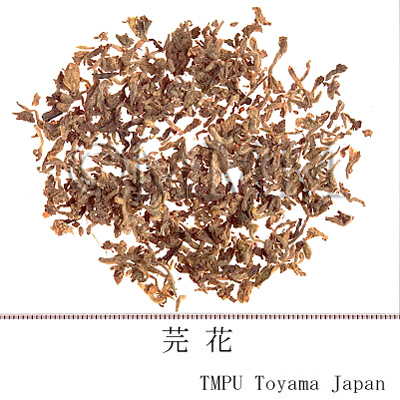
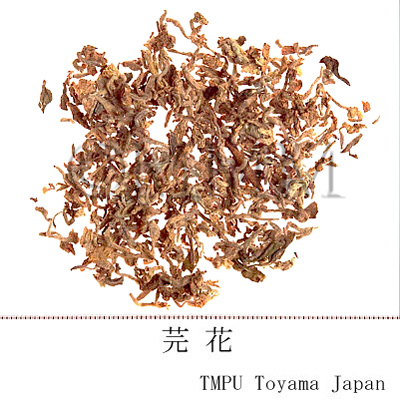
Crude drug name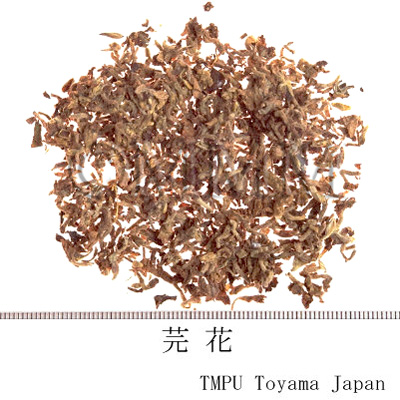 | Market name | 芫花 |
|---|---|---|
| Formal name | 芫花 | |
| Japanese name | げんか, Genka | |
| Vernacular name | Yuanhua | |
| Latin name | Genkwa Flos (CP) | |
| English name | Lilac Daphne Flower Bud (CP) | |
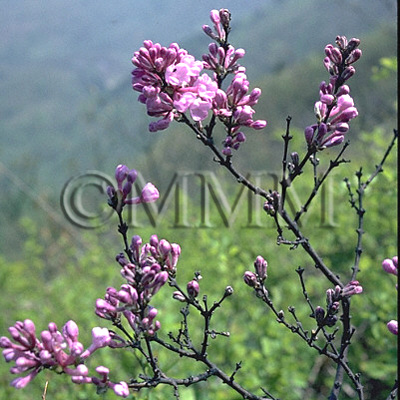
| Original plant name | Daphne genkwa Sieb. et Zucc., (Fujimodoki) | |
| Family name | Thymelaeaceae | |
| Used part | Classification | Plant origin | Sub classification | flos |
| Production area information | People's Republic of China, Hubei Prov. | |
| Collection information | People's Republic of China, Wuhan , Trade Center of Chinese Drug, Wuhan , Trade Center of Chinese Drug, Wuhan | |
| Collection date | 1987/11/10 | |
| Collector | Tsuneo Namba, et al. | |
| TMPW No. | 7827 | |
The capital city, provincial capital city or the representative
location of its administrative area is indicated.
location of its administrative area is indicated.
30.592849
114.30553899999995
Production area information
People's Republic of China,Hubei Prov.
https://ethmed.toyama-wakan.net/img/pin_san.png
30.592849
114.30553899999995
Collection information
People's Republic of China,Wuhan
https://ethmed.toyama-wakan.net/img/pin_nyu.png
Scientific information data base
| Common name | 芫花, Yuanhua, Genkwa Flos (CP), Lilac Daphne Flower Bud (CP) | |||||
|---|---|---|---|---|---|---|
| crude drug image |
| |||||
| Original plant name | Daphne genkwa Siebold et Zuccarini, (Fujimodoki, (Chōjizakura)) | |||||
| original plant image |
| |||||
| Family name | Thymelaeaceae | |||||
| Used part | flos | |||||
| Quality for selection | Those consisting only of flower buds collected before flowering, with intact (well-formed) flowers, strong bitterness, and a strong aroma are considered superior in quality (NI). | |||||
| Official compendium | CP (2025 ed.) | |||||
| Clinical application | It is used as a drastic laxative, diuretic, and expectorant, and is applied to cardiac asthma, edema with abdominal distension, and gastric and duodenal ulcers. It is contraindicated in individuals with a weak constitution and in pregnant women. | |||||
| Medical system | Traditional Chinese medicine | |||||
| Drug effect in traditional medicine | Traditional classification | Purgatives for removing water retention | ||||
| Beneficial effect | [Property and Flavor] Warm; bltter and pungent; toxic. [Meridian Tropism] Lung, spleen and kidney meridians. [Actions] To expel retained fluid by purgation; external application: to kill worms to treat sore. [Indications] Edema distention and fullness, hydrothorax and ascites, phlegm-fluid retention, aggregation and accumulation, cough and panting caused by qi counterflow, inhibited of defecation and urination; External application: scabies and tinea, favus, swelling abscess, frostbite. | |||||
| Chemical constituent | Sterols (*C1): Sitosterol Flavones & Flavonols (*C1): Genkwanin, Apigenin, Hydroxygenkwanin Other aromatic derivatives (*C1): Benzoic acid | |||||
| Pharmacological effect | Antifungal (water leaching: cutaneous fungus). Diuresis (decoction). Decrease in the blood pressure, uterine contraction, hyperpnea (genkwanin). Antiussive, expectorant (hydroxygenkwanin). | |||||
| DNA sequence | AF022132 | |||||
| Classical reference (Chinese Herbal Classic "Zhenglei bencao") | 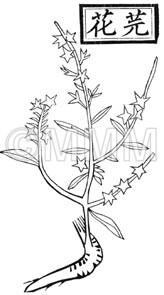 ※Click this image to see the actual image ※Click this image to see the actual image | |||||
| Disease | Ascites, Edema, Oliguria, Constipation, Pleural effusion, Cough, Chest pain, Pain of lateral sides of trunk, Head trichophytosis, Roundworm | |||||
| Formulation | rarely used in formula | |||||
| References | CP0: Pharmacopoeia of the People's Republic of China 2025 edi. C1)The Encyclopedia of Wakan-Yaku with Color Pictures Vol. II, p 112. | |||||
| Remarks | It is often confused with or substituted by Jōka (flower buds of Wikstroemia chamaedaphne Meissn.). | |||||
| Last renewal date | 2026/05/19 | |||||