
Crude drug sample data base
※Click on the image to enlarge it.
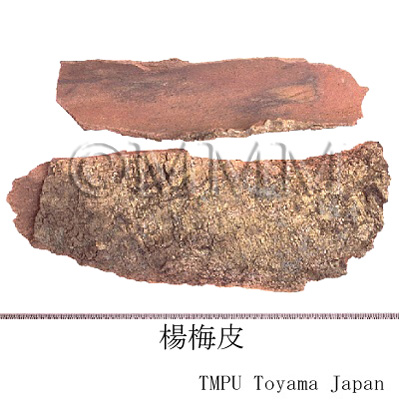
Crude drug name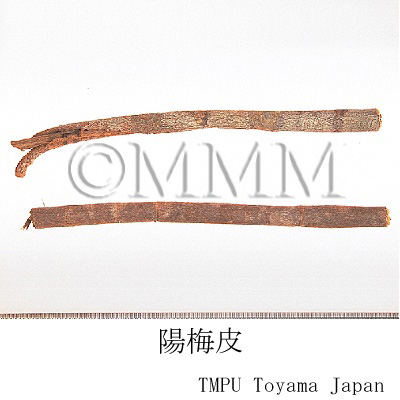 | Market name | 陽梅皮 |
|---|---|---|
| Formal name | 陽梅皮 | |
| Japanese name | ようばいひ, yobaihi | |
| Vernacular name | yangmeipi | |
| Latin name | Myricae Cortex (Non-JPS) | |
| English name | Myrica Rubra Bark (Non-JPS) | |
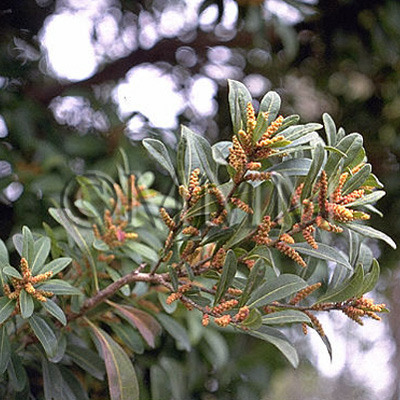
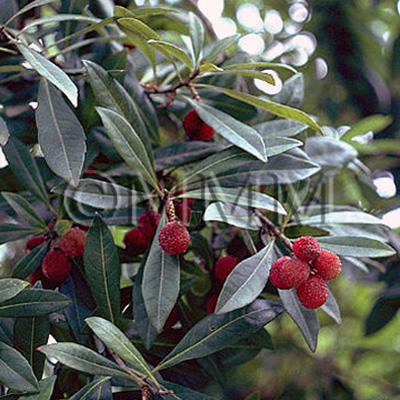
| Original plant name | Myrica rubra Sieb. et Zucc., (yamamomo) | |
| Family name | Myricaceae | |
| Used part | Classification | Plant origin | Sub classification | bark |
| Collection information | Hong Kong, Wing Tai Hong Medicine Co.,Ltd. | |
| Collection date | 1974/12/25 | |
| TMPW No. | 8843 | |
Scientific information data base
| Common name | 楊梅皮, Yangmeipi, Myricae CortexNon-JPS, Myrica Rubra BarkNon-JPS | ||||
|---|---|---|---|---|---|
| crude drug image |
| ||||
| Original plant name | Myrica rubra Siebold et Zuccarini , (Yamamomo) | ||||
| original plant image |
| ||||
| Family name | Myricaceae | ||||
| Used part | bark | ||||
| Official compendium | Non-JPS (2022) | ||||
| Clinical application | It is used as an astringent, antibacterial, insecticidal, and detoxifying agent in folk medicine for diarrhea when taken internally, and for contusions and swelling with pain when applied externally. It is also used as a dye. | ||||
| Medical system | Traditional Chinese medicine | ||||
| Chemical constituent | Flavones & Flavonols (*C1): Myricetin 1.5%, Myricitrin Tannins (*C1): タンニン/tannin 約15% | ||||
| Chemical structure | 
※画像をクリックすると、拡大して表示されます。 | ||||
| Pharmacological effect | Diuresis, vasoconstriction (myricitrin, myricetin). | ||||
| DNA sequence | AF119179, AF206967, L01934, U92857 | ||||
| Classical reference (Chinese Herbal Classic "Zhenglei bencao") | 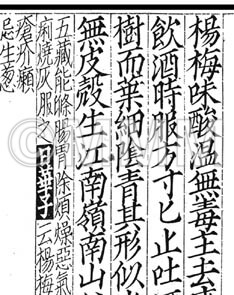 ※Click this image to see the actual image ※Click this image to see the actual image | ||||
| Disease | Diarrhea, Contusion | ||||
| Formulation | |||||
| References | Non-JPS: The Japanese standards for non-Pharmacopoeial crude drugs 2022. C1)The Encyclopedia of Wakan-Yaku with Color Pictures Vol. II, pp 157-158. | ||||
| Remarks | The root bark of Myrica cerifera L. produced in northeast of the United States is used to relieve diarrhea as astringent and aphrodisiac. | ||||
| Last renewal date | 2026/07/17 | ||||