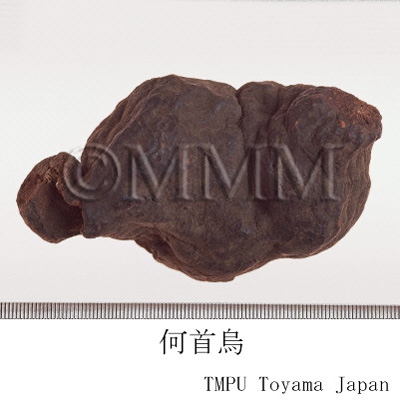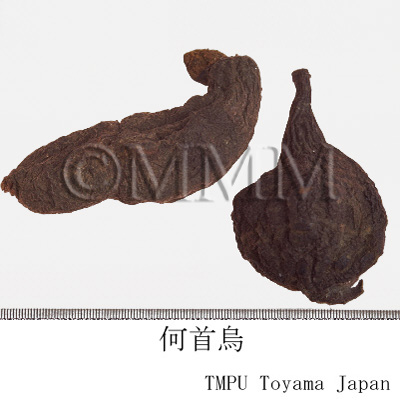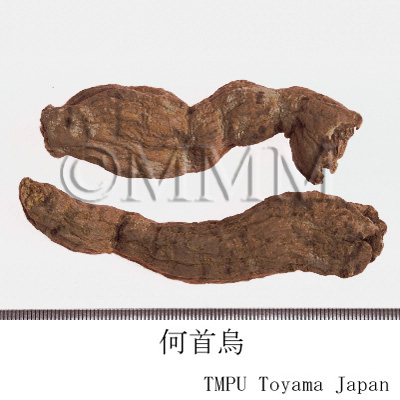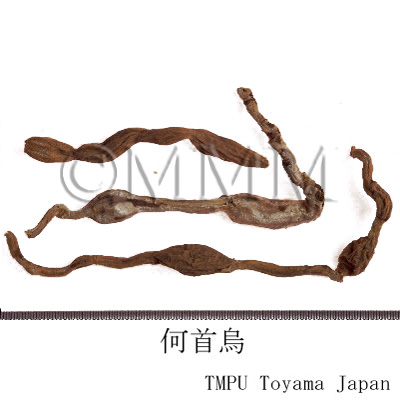

Crude drug sample data base
※Click on the image to enlarge it.
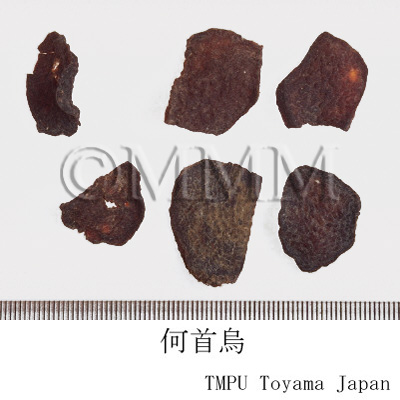
Crude drug name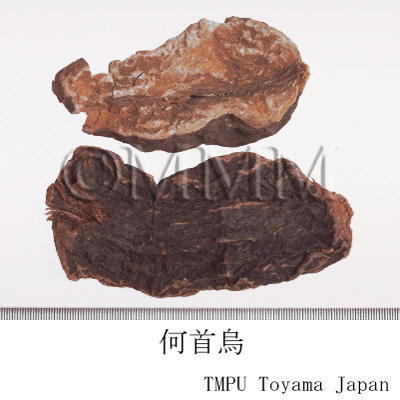 | Market name | 何首烏 |
|---|---|---|
| Formal name | 何首烏 | |
| Japanese name | かしゅう, Kashū | |
| Vernacular name | Uheosu | |
| Latin name | Polygoni Multiflori Radix (JP), (CP) | |
| English name | Polygonum Root (JP), Fleeceflower Root (CP) | |
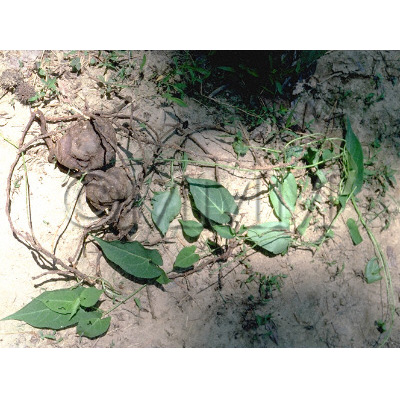
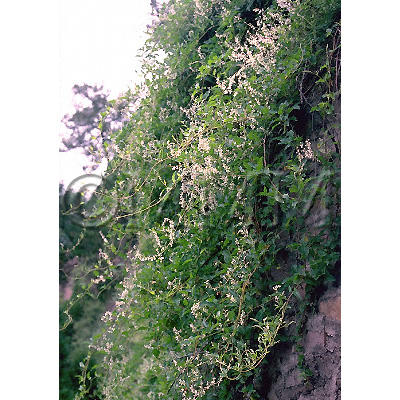
| Original plant name | Polygonum multiflorum Thunb., (Tsurudokudami) | |
| Family name | Polygonaceae | |
| Used part | Classification | Plant origin | Sub classification | tuber |
| Collection information | Republic of Korea, Taegu | |
| Collection date | 1973/09/00 | |
| TMPW No. | 940 | |
The capital city, provincial capital city or the representative
location of its administrative area is indicated.
Production area information
https://ethmed.toyama-wakan.net/img/pin_san.png
35.8714354
128.601445
Collection information
Republic of Korea,Taegu
https://ethmed.toyama-wakan.net/img/pin_nyu.png
Scientific information data base
| Common name | 何首烏, Heshouwu, Polygoni Multiflori RadixJP,CP, Polygonum RootJP, Fleeceflower RootCP | |||||
|---|---|---|---|---|---|---|
| crude drug image |
| |||||
| Original plant name | Polygonum multiflorum Thunberg, (Tsurudokudami) | |||||
| original plant image |
| |||||
| Family name | Polygonaceae | |||||
| Used part | tuber | |||||
| Quality for selection | Large ones with a bead-like shape, a pale reddish floral pattern on the cross-section where the root has been detached, and five deep longitudinal grooves on the surface are considered to be of good quality (NI). | |||||
| Official compendium | JHMC (1989), CP (2025 ed.), JP XIX | |||||
| Clinical application | Used as a tonic, aphrodisiac, blood tonic, and laxative to treat conditions such as deficiency of essence and blood, pain in the lower back and knees, seminal emission, leukorrhea, and premature graying of the hair. | |||||
| Medical system | Traditional Chinese medicine | |||||
| Drug effect in traditional medicine | Traditional classification | Drugs for nourishing the blood | ||||
| Beneficial effect | [Property and Flavor] Mild warm; bitter, sweet and astringent. [Meridian Tropism] Liver, heart and kidney meridians. [Actions] To remove toxin, disperse abscesses, interrupt malaria, and moisten the intestines to relax the bowels. [Indications] Sore and abscess, scrofula, itching caused by rubella, weak constitution caused by long-term malaria, constipation caused by intestinal dryness. | |||||
| Chemical constituent | Anthraquinones (*C1): Chrysophanol, Emodin Tannins (*C1): Tannin Stilbenes (*C2): 2,3,5,4'-Tetrahydroxystilbene-2-O-beta-D-glucoside Indole alkaloids (*C3): Indole-3-(L-alpha-amino-alpha-hydroxypropionic acid) methyl ester | |||||
| Chemical structure | 
※画像をクリックすると、拡大して表示されます。 | |||||
| Pharmacological effect | Promotes intestinal motility (aqueous extract). Inhibits cholesterol absorption from the intestinal tract. Exhibits corticotropin-like activity. | |||||
| Classical reference (Chinese Herbal Classic "Zhenglei bencao") | 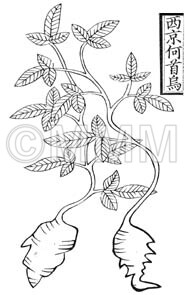 ※Click this image to see the actual image | |||||
| Disease | Lightheadedness, Bleary eyes, Vertigo, Ear buzzing, Heaviness and powerlessness in lumber and knee, Numbness, Alopecia, Premature gray hair, Spermatorrhea, Chill, Fever, Pyogenic dermatosis, Cervical lymphadenopathy, Itching, Constipation, Hyperlipidemia | |||||
| Formulation | Tokiinshi | |||||
| Related drugs | The root of Cynanchum auriculatum, C. bungei, C. wilfordii and etc. | |||||
| References | JP: The 19th edition of the Japanese Pharmacopoeia. CP: Pharmacopoeia of the People's Republic of China 202 edi. C1)The Encyclopedia of Wakan-Yaku with Color Pictures Vol. I, p 77. C2)Outline of Pharmacognosy, a Textbook, p 314. C3)Zhong Cao Yao,29,5(1998). | |||||
| Remarks | Baiheshouwu (白何首烏) is the root of Cynanchum auriculatum Royle of family Asclepiadaceae, C. bungei Dcne. (Jap. name: Koikema) , C. wilfordii Hemsl. and other species. | |||||
| Last renewal date | 2026/11/06 | |||||