
Crude drug sample data base
※Click on the image to enlarge it.
Crude drug name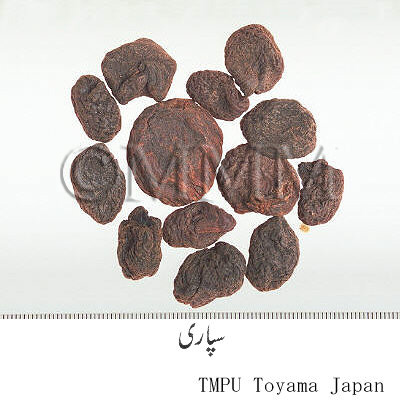 | Market name | Chaliya |
|---|---|---|
| Urudu name | Supari | |
| Arabic name / Persian name | Faufal Mufawwar / Paupal | |
| English name | Betal nut palm, Areca nut | |
| Original plant name | Areca catechu Linn., Betal nut palm, Areca nut | |
| Family name | Araceae | |
| Used part | Classification | Plant origin | Sub classification | fruit |
| Collection information | Islamic Republic of Pakistan, Karachi [Karachi], Sind , Amjad Unani Medicine (Pvt.) Ltd. , Amjad Unani Medicine (Pvt.) Ltd. | |
| Collection date | 1994/1/22 | |
| Collector | Tsuneo Namba | |
| Identifier | Javed Ahmad | |
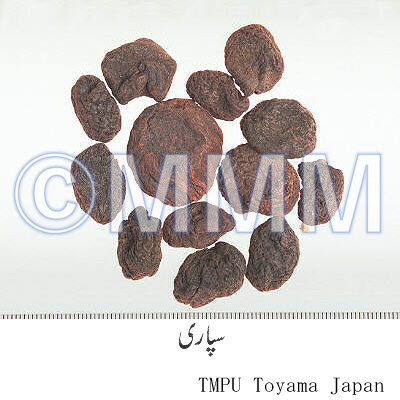
| Description | Features: The drug Faufal (A. catechu) consists of roundish seeds of about nutmeg size (2.0-2.5cm), flattened at the base, externally reddish brown or rusty grey in colour and marked conspicuously with a hilum. Brownish testa is very thin and closely adherent to inner layers. The endosperm is whitish and of ruminated type. Areca nuts have no marked odour and feebly astringent and bitter in taste. | |
| TMPW No. | 14406 | |
The capital city, provincial capital city or the representative
location of its administrative area is indicated.
location of its administrative area is indicated.
Production area information
https://ethmed.toyama-wakan.net/img/pin_san.png
25.0700428
67.2847875
Collection information
Islamic Republic of Pakistan,Karachi [Karachi], Sind
https://ethmed.toyama-wakan.net/img/pin_nyu.png
Scientific information data base
| Crude drug name | Urudu name, English name | Supari (nuts); Gul-i-Supari (flowers), Betal nut palm, Areca nut | |||
|---|---|---|---|---|---|
| Arabic name / Persian name | Faufal Mufawwar / Paupal (nuts); Faufal / Gul-i-Paupal (flowers) | ||||
| crude drug image |
| ||||
| Original plant name | Areca catechu Linn. | ||||
| Family name | Arecaceae | ||||
| Used part | Nut | ||||
| Distribution area | A slender-stemmed, erect palm; native of Malaysia, now grown along the coasts of Karnataka, Kerala, Tamil Nadu, West Bengal, Assam and Maharashtra. Areca nuts consist of hard and fibrous outer covering commonly called husk, enclosing within its endosperm which is edible nut. | ||||
| Description | Faufal is the fruit of an Indian plant resembling the nutmeg except the former is red in colour and hard to break. When broken, all of its pieces are scattered. It has a pleasant odour. Therefore, the Indians use it for the sake of fragrance. It imparts a red colour to the teeth (with some ingredients). Its potency is equal to that of sandalwood. | ||||
| Function and properties | Excretion, Swellings. Astringent, stimulant, masticatory, remove bad taste from the mouth, anthelmintic, emmenagogue, repercussive, resolvent of inflammations (of warm origin). Stimulant for the peristaltic movement of intestines and bowels. It is a cooling drug. | ||||
| Specific actions | Astringent, anthelmintic and repercussive (especially for inflammations of hot origin). | ||||
| Frequency in use | Very common. | ||||
| Common uses | The betel nuts are recommended in the form of powder in case of diarrhoea/diarrhea and dysentery. Its plaster is applied on hot and hard swellings. It is also applied to bleeding gums to strengthen teeth. In conjunctivitis and epiphora the nut is made into ash and applied as collyrium for the relief. Being astringent it is useful in the atony of uterus, leucorrhoea/leucorrhea and spermatorrhoea/spermatorrhea. | ||||
| Side effect | About 30gm of betel nuts are practically reported to be non-toxic, however, fresh nuts which is commonly not used in Unani medicines are somewhat intoxicating and may produce giddiness in some individuals. It causes roughness in the pectoral region and may become a cause of stones in kidney and bladder. | ||||
| Medical system | Unani | ||||
| Traditional concept | Temperament | It is cold and dry in the second degree. According to Avicenna (Ibn Sina) it is cold and dry in the third. | |||
| Drug effect | It strengthens the teeth and gums on chewing. | ||||
| Dosage | 3 to 5 gm (powdered and dried). | ||||
| Substitute | Sandal (Santalum album Linn.). | ||||
| Corrigent (corrective) | Katira (Cochlospermum religiosum (L.) Alston) and Ilaichi Khurd (Elettaria cardamomum (L.) Maton.). | ||||
| Important compound preparations | Ma`jun Supari Pak, Ma`jun Kalan and Ma`jun Mochras. | ||||
| References | Reference book Tips! | Glossary of Indian Medicinal Plants, 1956. Chopra, R.N., Nayar, S.L. and Chopra, I.C., Council of Scientific & Industrial Research, New Delhi. - New Edition (1996) National Institute Science Communication; Supplement p 124. Indian Medicinal Plants (Second Edition), Vols. 1-5, 1993. Kirtikar, K.R. and Basu. B.D., Periodical Experts Book Agency, Delhi Vol. 3, p 1662. Makhzanul-Mufradat (Khawasul Adviyah), Hakeem Kabiruddin, Daftar Al-Masih, Qarol Bagh, Delhi. p 409. Al-Qanun Fil-Tibb. Avicenna. (English translation of the critical Arabic text), Book 2, 1998. Hameed, H. A. (editor), Dept. of Islamic Studies, Jamia Hamdard (Hamdard University), New Delhi. p 337. Al-Jamili Mufradt Al Adwiya Wal Aghziya (1197-1248 A.D.). Ibn al-Baytar. Vols. 1-3, 1985-1999. Central council for Research in Unani Medicine, Janakpuri, New Delhi. Vol. 3, pp 326-327. Hamdard Pharmcopoeia of Eastern medicine, 1969. Said, H. M. (editor), The Times Press, Sadar Karachi. p 270. Indusyunic Medicine, 1997. Usmanghani, K., Saeed, A. and Alam, M. T. Department of Pharmacognosy, Faculty of Pharmacy, University of Karachi, Karachi. pp 209-210. Unani Adwiyah Mufradah, 1984. Ali, Saifuddin, A. (3rd edi.). Taraqi-e-Urdu Bureau, R. K. Puram, New Delhi. p 208. The Encyclopedia of Medicinal Plants, 1996. Andrew Chavallier, DK Publishing Inc., New York. p 160. | |||
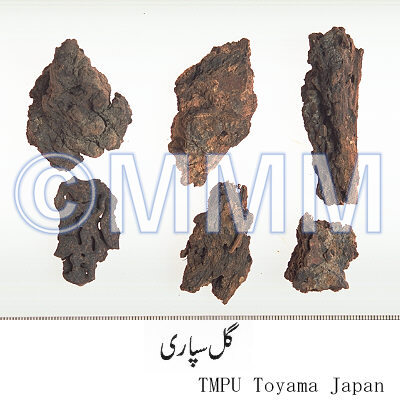
| Remarks | Its Unani name is Faimutus or Gird Chob. The drug is described by all Unani physicians. Indian betel nut is considered superior. In India, Bangladesh and Pakistan it is chewed with betel leaf, lime and catechu. Gul supari (flowers) are also used in Unani medicine. | ||||
| Last renewal date | 2024/02/26 | ||||