
Crude drug sample data base
※Click on the image to enlarge it.
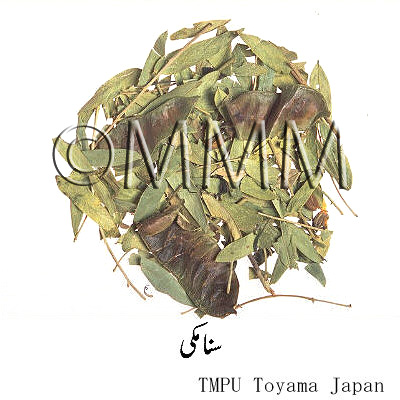
Crude drug name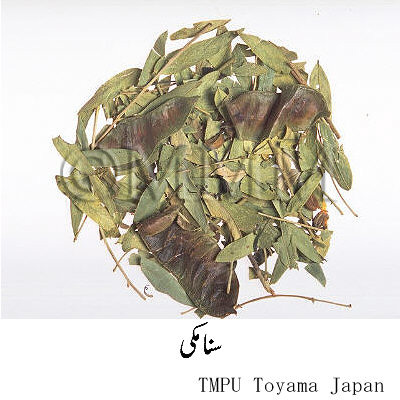 | Market name | Sana-makki |
|---|---|---|
| Urudu name | Sanna-Makki | |
| Arabic name / Persian name | Sanna-Makki / Sanna-Makki | |
| English name | Senna | |
| Original plant name | Cassia angustifolia Vahl., Senna | |
| Family name | Caesalpiniaceae (Former Leguminosae) | |
| Used part | Classification | Plant origin | Sub classification | leaf |
| Collection information | Islamic Republic of Pakistan, Karachi [Karachi], Sind , Amjad Unani Medicine (Pvt.) Ltd. , Amjad Unani Medicine (Pvt.) Ltd. | |
| Collection date | 1994/1/22 | |
| Collector | Tsuneo Namba | |
| Identifier | Javed Ahmad | |
| Description | Features: An erect shrub, leaves pinnate, flowers yellow and pods flat with 5 to 6 seeds. Leaflets ovate lanceolate, tapering from the middle towards the apex from 2.5 to 5cm long. Legumes flat with the base of the style distinctly, cuneate and compressed. | |
| TMPW No. | 14418 | |
The capital city, provincial capital city or the representative
location of its administrative area is indicated.
location of its administrative area is indicated.
Production area information
https://ethmed.toyama-wakan.net/img/pin_san.png
25.0700428
67.2847875
Collection information
Islamic Republic of Pakistan,Karachi [Karachi], Sind
https://ethmed.toyama-wakan.net/img/pin_nyu.png
Scientific information data base
| Crude drug name | Urudu name, English name | Sanna-Makki, Senna | ||
|---|---|---|---|---|
| Arabic name / Persian name | Sanna-Makki / Sanna-Makki | |||
| crude drug image |
| |||
| Original plant name | Cassia angustifolia Vahl. | |||
| Family name | Caesalpiniaceae (Former Leguminosae) | |||
| Used part | Leaves | |||
| Distribution area | Introduced and successfully grown in Tinnevelley (Tamil Nadu) and South India. It is also found in Arab, Syria and Egypt. | |||
| Function and properties | Skin, Fevers, Joints, Alimentary organs, Excretion. Cathartic (purgative of the malhumours), laxative, deobstruent, blood purifier, anthelmintic, produces gripes in intestines and brings vomiting. | |||
| Specific actions | Purgative of the malhumours. | |||
| Frequency in use | Common under cultivation. | |||
| Common uses | Skin: It is regarded as blood purifier, therefore, also prescribed in chronic skin ailments. Fevers: The leaves are regarded of benefit in periodic fevers when not relieved by desired drugs. Joints: It is regarded of benefit in rheumatism of phlegmatic or bilious origin (i.e. be of yellow bile disorder or atrabile), backache, sciatica and gout. Alimentary organs: Largely recommended for use in constipation, loss of appetite, liver complaints, abdominal cramps, splenic enlargements, dyspepsia, jaundice and anemia. Excretion: The leaves of senna are required as an active purge. It is useful in evacuating the malhumours. | |||
| Side effect | The drug is regarded as emetic and may be a cause of colic (when used) therefore, never advised to be taken alone but as corrective among rose or rose preserve and anise. It may also cause agony or anguish. Large doses may produce intestinal irritation, tenesmus, nausea, intestinal colic and abortion. | |||
| Medical system | Unani | |||
| Traditional concept | Temperament | It is hot and dry in the first degree but according to others it is hot in the second and dry in the first degree. Its leaves are like henna. The leaves are used in Unani medicine. The best senna is that which is procured from Makkah (Arab). | ||
| Drug effect | Purgative of the malhumours. | |||
| Dosage | 3 to 5gm. (common dose). 7 to 9gm. (for the purpose of purgation). | |||
| Substitute | Turbud (Operculina turpethum (L.) Silva-Manso syn. Ipomoea turpethum (L.) R. Br.) | |||
| Corrigent (corrective) | Roghan badam, oil of almond and Gulab Ke Phool (Rosa damascena Mill.), rose. | |||
| Important compound preparations | Itrifal Aftimun, Itrifal Sanai, Ma`jun Ushba, Sherbat Mushil, Ma`jun Sana. | |||
| References | Reference book Tips! | Indian Materia Medica, Vols. 1-2, 1976 (Repr. 1989). Nadkarni, A.K., Popular Prakashan Pvt. Ltd., Bombay Vol. 1, p 284. Makhzanul-Mufradat (Khawasul Adviyah), Hakeem Kabiruddin, Daftar Al-Masih, Qarol Bagh, Delhi. pp 355-356. A Survey of Drugs, 1961 (2nd edi.). Wahid, A. K. and Siddiqui, H. H. Institute of History of Medicine and Medical Research, Delhi. p 11. Dictionary of Economic Plants in India, 1996 (2nd Rep.). Singh, U; Wadhwani, A. M. and Johri B.M. Indian council of Agricultural Research, New Delhi. p 44. Al-Jamili Mufradt Al Adwiya Wal Aghziya (1197-1248 A.D.). Ibn al-Baytar. Vols. 1-3, 1985-1999. Central council for Research in Unani Medicine, Janakpuri, New Delhi. Vol. 3, pp 87-88. Indusyunic Medicine, 1997. Usmanghani, K., Saeed, A. and Alam, M. T. Department of Pharmacognosy, Faculty of Pharmacy, University of Karachi, Karachi. pp 145-146. Unani Adwiyah Mufradah, 1984. Ali, Saifuddin, A. (3rd edi.). Taraqi-e-Urdu Bureau, R. K. Puram, New Delhi. p 187. | ||
| Remarks | Senna leaves are considered very important and never used alone, these are administered after mixing with rose or rose preserve and anise as stated by Unani physicians. It is in the list of Indian drugs which were introduced by Unani physicians in the indigenous medicine. | |||
| Last renewal date | 2024/03/13 | |||