

Crude drug sample data base
※Click on the image to enlarge it.
Crude drug name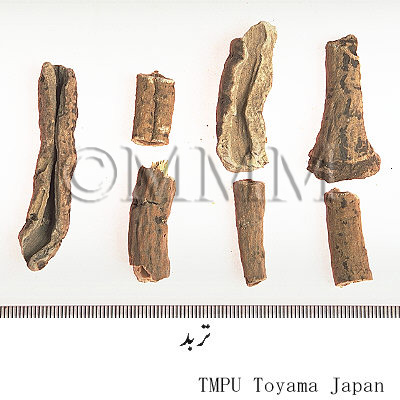 | Market name | Turbud-safaid |
|---|---|---|
| Urudu name | Turbud | |
| Arabic name / Persian name | Turbud / | |
| English name | Turpeth | |
| Original plant name | Marsdenia tenacissima W. & A., Turpeth | |
| Family name | Asclepiadaceae | |
| Used part | Classification | Plant origin | Sub classification | root |
| Collection information | Islamic Republic of Pakistan, Karachi [Karachi], Sind , Amjad Unani Medicine (Pvt.) Ltd. , Amjad Unani Medicine (Pvt.) Ltd. | |
| Collection date | 1994/1/22 | |
| Collector | Tsuneo Namba | |
| Identifier | Javed Ahmad | |
| Description | Features: Stem pieces of M. tenacissima are generally sold by the name of Safaid turbud. These pieces are hollow from inside as the central pith is taken out, 1 to 2cm in diameter, external surface twisted and it is sharp ash coloured. Odour - mild. | |
| TMPW No. | 14532 | |
The capital city, provincial capital city or the representative
location of its administrative area is indicated.
location of its administrative area is indicated.
Production area information
https://ethmed.toyama-wakan.net/img/pin_san.png
25.0700428
67.2847875
Collection information
Islamic Republic of Pakistan,Karachi [Karachi], Sind
https://ethmed.toyama-wakan.net/img/pin_nyu.png
Scientific information data base
| Crude drug name | Urudu name, English name | Turbud, Turpeth |
|---|---|---|
| Arabic name / Persian name | Turbud / - | |
| Original plant name | Operculina turpethum (Linn.) Silva Manso syn. Ipomoea turpethum R. Br. | |
| Family name | Convolvulaceae | |
| Used part | Root | |
| Distribution area | The museum sample constitutes the drug white turpeth. Marsdenia tenacissima is found in northwestern Himalayas, Madhya Pradesh, Bihar, and Deccan Peninsula. Root or stem constitute the drug white turpeth. | |
| Description | The real source of turbud is the root of Operculina turpethum (Linn) Silva Manso syn. Ipomoea turpethum R. Br. (Fam. Convolvulaceae). A common twining herb found in India. Nowadays in the market two types of turbud material is available i.e. white and black. The functions and properties of both are similar according to Unani literature. The black one is accepted to be toxic or poisonous. The best variety of turbud is one which is free from worms, white in appearance, it can be readily pulverized, is hollow like a thin cane, smooth, easy to be broken and not very thick. The worm eaten, very light and perforated variety of turbud is weak. To improve its properties, the dust-coloured peel of trubud should be removed to such an extent that its whiteness becomes visible. Its powder should then be kept in almond oil. Taste – acrid and sharp. | |
| Function and properties | Stomach, Joints and nervine diseases, Excretions. Drastic purgative of phlegmatic humours and bile, increases secretion of biliary (as well as phlegmatic) matter and renders it more watery, hepatic stimulant and cathartic. | |
| Specific actions | Cathartic, antiphlegmatic (with chebulic myrobalan), antiepileptic and useful against melancholia. | |
| Frequency in use | Both are commonly found in India. | |
| Common uses | Stomach: It purifies stomach and corrects the liver. Joints and nervine diseases: It is useful for nervine diseases. Turpeth is best administered in combination with other herbal drugs particularly beneficial in rheumatic, paralytic, epileptic affections and in compound preparations as hepatic stimulant, cathartic and laxative, in melancholia, gout, dropsy, leprosy etc. Excretions: Turbud purges out much phlegm but it expels burnt humour in relatively lesser quantity. This is so when it is taken as a powder, but if it is taken as a decoction, the result would be reverse. Masarjawaih states that turbud purges out thick and viscous humours. Some other physicians are of the opinion that it purges out immature humours from the hips. It is more correct to say that turbud purges out thin phlegm, but it is made more potent by mixing with dry ginger, it would also be able to purge out the thick and immature humours. To reduce weight and fatness this is a remedy described by traditional physicians (but not in continuous use for this purpose due to its potential cathartic action). Ginger is considered as best combination to intensify its action. | |
| Side effect | It induces loose watery motion, nausea and harmful to intestines and causes nausea, colic, watery mucus containing discharges or stools and bloody motions, if used alone. It also produces grief or distress. | |
| Medical system | Unani | |
| Traditional concept | Temperament | It is hot in the second, dry in the first degree. According to others it is hot and dry in the third degree. |
| Drug effect | It is beneficial as an anti-phlegmatic and useful in the disorders of brain (with chebulic myrobalan). | |
| Dosage | 3 to 5gm. (in powdered form). 5 to 12gm. (as a decoction). | |
| Substitute | Ghariqun (Polyporus officinalis Fries) and Kaladana (Ipomoea hederacea (L.) Jacq.) | |
| Related drugs | Marsdenia tenacissima W. & A. (Fam. Asclepiadaceae; Eng. Rajmahal hemp). Commercial samples are frequently adulterated with pieces of the stem which are sometimes winged and greyish white in colour. Stem pieces of Marsdenia tenacissima are generally sold by the name of Safaid Nisoth or turbud. | |
| Corrigent (corrective) | Decorticated root burned (fried) in almond oil. | |
| Important compound preparations | Jawarish Shahreyaran, Qurs Mulayyin, Itrifal Zamani and Habb-i-Ayarij. | |
| References | Reference book Tips! | Illustrated Manual of Herbal Drugs Used in Ayurveda, 1996. Sarin, Y.K., Council of Scientific & Industrial Research and Indian Council of Medical Research, New Delhi p 108. Indian Materia Medica, Vols. 1-2, 1976 (Repr. 1989). Nadkarni, A.K., Popular Prakashan Pvt. Ltd., Bombay Vol. 1, pp 691-694. Makhzanul-Mufradat (Khawasul Adviyah), Hakeem Kabiruddin, Daftar Al-Masih, Qarol Bagh, Delhi. pp 193-194. A Survey of Drugs, 1961 (2nd edi.). Wahid, A. K. and Siddiqui, H. H. Institute of History of Medicine and Medical Research, Delhi. pp 19-30. Dictionary of Economic Plants in India, 1996 (2nd Rep.). Singh, U; Wadhwani, A. M. and Johri B.M. Indian council of Agricultural Research, New Delhi. pp 135, 157. Al-Qanun Fil-Tibb. Avicenna. (English translation of the critical Arabic text), Book 2, 1998. Hameed, H. A. (editor), Dept. of Islamic Studies, Jamia Hamdard (Hamdard University), New Delhi. p 121. Al-Jamili Mufradt Al Adwiya Wal Aghziya (1197-1248 A.D.). Ibn al-Baytar. Vols. 1-3, 1985-1999. Central council for Research in Unani Medicine, Janakpuri, New Delhi. Vol. 1, pp 339-341. Indusyunic Medicine, 1997. Usmanghani, K., Saeed, A. and Alam, M. T. Department of Pharmacognosy, Faculty of Pharmacy, University of Karachi, Karachi. pp 319-320. Unani Adwiyah Mufradah, 1984. Ali, Saifuddin, A. (3rd edi.). Taraqi-e-Urdu Bureau, R. K. Puram, New Delhi. pp 111-112. |
| Remarks | Stem/root and root bark of white turpeth (Marsdenia tenacissima) which are in common use are cathartic and laxative; the dark variety ''black turpeth'' (Operculina turpethum), it is also in use. The real source of turbud is the root of Operculina turpethum syn. Ipomoea turpethum. But according to Hakeem Saifuddin both the drugs have similar actions and properties. Marsdenia tenacissima is used in Unani System of Medicine. The black one (Operculina turpethum) which is considered poisonous is in common use in Ayurvedic System of Medicine. Hekeem Saifuddin states that the drug, if used with chebulic myrobalan, becomes useful in melancholia, insanity and epilepsy. He further states that the drug alone is useful in dropsy, piles, gout, rheumatism, sciatica, obesity and facial paralysis. | |
| Last renewal date | 2024/03/18 | |