

Crude drug sample data base
※Click on the image to enlarge it.
Crude drug name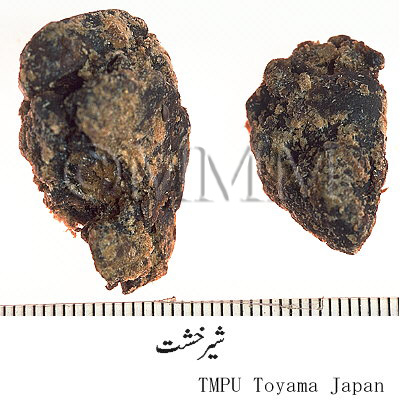 | Market name | Shir Khisht |
|---|---|---|
| Urudu name | Shir khisht | |
| Arabic name / Persian name | Shir khisht / Shir khisht | |
| English name | Manna ash | |
| Original plant name | Fraxinus ornus Linn., Manna ash | |
| Family name | Oleaceae | |
| Used part | Classification | Plant origin | Sub classification | extract |
| Collection information | People's Republic of Bangladesh, Dacca [Dhaka] , Essa Bros. & Co. , Essa Bros. & Co. | |
| Collection date | 1964/3/6 | |
| Collector | Tsuneo Namba | |
| Identifier | Javed Ahmad | |
| Description | This contains sugary exudate of stem. | |
| TMPW No. | 9678 | |
The capital city, provincial capital city or the representative
location of its administrative area is indicated.
location of its administrative area is indicated.
Production area information
https://ethmed.toyama-wakan.net/img/pin_san.png
23.810332
90.41251809999994
Collection information
People's Republic of Bangladesh,Dacca [Dhaka]
https://ethmed.toyama-wakan.net/img/pin_nyu.png
Scientific information data base
| Crude drug name | Urudu name, English name | Shir khisht, Manna ash | ||
|---|---|---|---|---|
| Arabic name / Persian name | Shir khisht / Shir khisht | |||
| crude drug image |
| |||
| Original plant name | Fraxinus ornus Linn. | |||
| Family name | Oleaceae | |||
| Used part | Sugary exudate of stem | |||
| Distribution area | It is found in the mountains of S. Europe and Asia Minor, extending in the Mediterranean region westwards upto E. Spain. It is also found in Khurasan (Iran). | |||
| Description | Manna is obtained by incision from the stem (or exudes itself from the plant of Fraxinus ornus or allied species). It is found in the congealed form. In bazaars two kinds of Shir Khisht are found. (i) Shir Khisht (English) which is strong / solid in structure and is sold in English drug stores. (ii) Shir Khist in the form of shedding tears. It is met in the forms of grains, which are large, round, soft, whitish brown, transparent and clear in structure like gum. Taste - extremely sweetish. It is more frequently used as a drug. | |||
| Function and properties | Fever, Chest, Excretion. Laxative, detergent, purgative for excess bile and biliousness, expectorant of phlegm, aphrodisiac, tonic and fattening. | |||
| Specific actions | Diuretic, antipyretic and antirheumatic. | |||
| Frequency in use | Imported into India. | |||
| Common uses | Fever: It is more commonly used as antipyretic with rose. It reduces fever. Chest: It is referred as best suited for sensitive individuals (temperamentally) and for children who have weak and lean posture. The round whitish brown dried exudation is administered as safe laxative, expectorant of phlegm and antibilious used in chest complaints like hoarseness, cough, bronchitis etc. Excretion: It is used to potentialise the purgative action and as corrective added with other laxatives used in tonic preparations administered for the purpose of increasing weight and as aphrodisiac. | |||
| Side effect | Large doses may cause flatulence, gurgling noise in the bowels and premature ejaculation. It is harmful for colic patients. | |||
| Medical system | Unani | |||
| Traditional concept | Temperament | Balanced temperament inclined towards hotness. | ||
| Drug effect | It is considered as a beneficial laxative, purgative for excess bile and curative for hot fevers. | |||
| Dosage | 24 to 48gm. | |||
| Substitute | Turanjabin Khurasani (Manna of Khurasan). | |||
| Related drugs | i) Fraxinus excelsior Linn. It is found in Italy and north temperament zone. ii) Fraxinus floribunda Wall. It is distributed in temperate Himalayas, from Kashmir to Bhutan, Assam and Khasi Hills. Exudation of this is a substitute for manna. | |||
| Corrigent (corrective) | Roghan badam (oil of almond), soaf (fennel) and gulab (rose). | |||
| Important compound preparations | Dawa al-Turanjaben, Sherbat Shafa and Qurs Tabasheer Mulayyin. | |||
| References | Reference book Tips! | Glossary of Indian Medicinal Plants, 1956. Chopra, R.N., Nayar, S.L. and Chopra, I.C., Council of Scientific & Industrial Research, New Delhi. - New Edition (1996) National Institute Science Communication; Supplement p 121. Indian Materia Medica, Vols. 1-2, 1976 (Repr. 1989). Nadkarni, A.K., Popular Prakashan Pvt. Ltd., Bombay Vol. 1, p 560. Makhzanul-Mufradat (Khawasul Adviyah), Hakeem Kabiruddin, Daftar Al-Masih, Qarol Bagh, Delhi. pp 390-391. Dictionary of Economic Plants in India, 1996 (2nd Rep.). Singh, U; Wadhwani, A. M. and Johri B.M. Indian council of Agricultural Research, New Delhi. p 88. Al-Qanun Fil-Tibb. Avicenna. (English translation of the critical Arabic text), Book 2, 1998. Hameed, H. A. (editor), Dept. of Islamic Studies, Jamia Hamdard (Hamdard University), New Delhi. p 295. Indusyunic Medicine, 1997. Usmanghani, K., Saeed, A. and Alam, M. T. Department of Pharmacognosy, Faculty of Pharmacy, University of Karachi, Karachi. pp 238-239. | ||
| Remarks | According to Unani physicians it has safe action on the relevant tissues and organs. Avicenna (Ibn Sina) states that it is similar to Turanjabin (Alhagi pseudalhagi (Bieb.) Desv.) in purgative property but is rather stronger in potency. The drug is exclusively used in Unani medicine. This is an esteemed drug for trade among European countries. The exudation has soft structure and boiling or intense heating may loose its pharmacological activity, therefore, it is not used in infusion form. | |||
| Last renewal date | 2024/03/13 | |||