
Crude drug sample data base
※Click on the image to enlarge it.
Crude drug name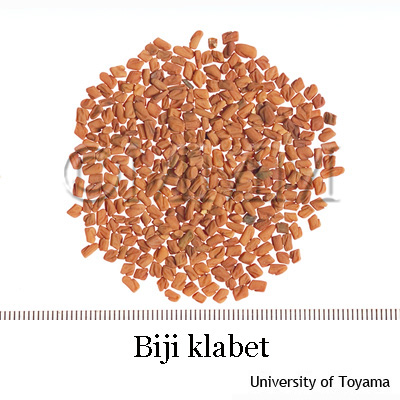 | Market name | Biji klabet |
|---|---|---|
| English name | Fenugreek | |
| Original plant name | Trigonella foenum-graecum Linn., Fenugreek | |
| Family name | Leguminosae | |
| Used part | Classification | Plant origin | Sub classification | seed |
| Collection information | Republic of Indonesia, Akar sari | |
| Collection date | 1980/01/16 | |
| Collector | Tsuneo Namba, et al. | |
| Identifier | Mangestuti Agil | |
| TMPW No. | 6727 | |
Scientific information data base
| Crude drug name | Indonesian name, English name | Klabet, Fenugreek | |||
|---|---|---|---|---|---|
| crude drug image |
| ||||
| Original plant name | Trigonella foenum-graecum Linn. | ||||
| Family name | Leguminosae | ||||
| Used part | Seeds, leaves | ||||
| Distribution area | Indigenous to the Medditerranean, it was once cultivated in Java Island [201]. | ||||
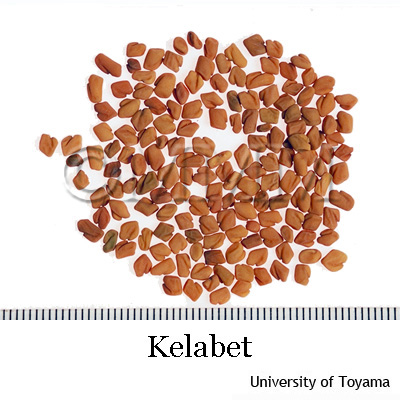
| Description | An erect annual herb, 30-60 cm. Fruits contain 10-20 seeds. Seeds are brownish-yellow of rhombic shape about 3 mm, deep furrow dividing them into 2 unequal lobes. Taste bitter and peculiar. | ||||
| Frequency in use | Moderate | ||||
| Common uses | It is used as a spice in cooking goat meat. Also to treat cold in horses [201]. | ||||
| Pharmacological effect | A study on the chemopreventive activities of Trigonella foenum-graecum Linn. against breast cancer showed that fenugreek seed's extract significantly inhibited the dimethylbenz anthracene -induced mammary hyperplasia and decreased its incidence [PMID:15936223]. On a research to study the effect of soluble dietary fiber fraction of Trigonella foenum-graecum Linn. on glycemic, insulinemic, lipidemic and platelet aggregation status of Type 2 diabetic model rat showed that the plant has a beneficial effect on dyslipidemia and has a tendency to inhibit platelet aggregation in Type 2 model diabetic rats [PMID:12902054]. Evaluation on the preventive efficacy of dietary fenugreek seeds and its major steroidal saponin constituents, diosgenin, on azoxymethane-induced rat colon carcinogenesis during initiation and promotion stages showed that diosgenin inhibits cell growth and induces apoptosis in the HT-29 human colon cancer cell line in a dose-dependent manner [PMID:15298963]. | ||||
| Medical system | Indonesian medicine (Jamu) | ||||
| Traditional usage | Treatment of asthma, cough, irregular menstruation, appetite stimulant, sore throat, digestive problems, haemorrhoids/hemorrhoids, abscesses, fallen hair and rheumatism. It is also used as a liniment and hair oil, poultice is used to reduce pain [201]. Seeds are used as carminative, tonic, aphrodisiac, cosmetic, and to treat smallpox. Leaves are for treating swellings, injury to the skin caused by heat, as a hair tonic [222]. | ||||
| Formulation | 1) Hair growth: 5 grams of powdered seeds of T. foenum-graecum is boiled in 100 ml of oil of Aleurites moluccana, let it stand overnight and use as a hair oil [231]. | ||||
| References | Reference book Tips! | [201] K. Heyne, Tumbuhan Berguna Indonesia, Vols. 1-4, 1987. Diedarkan Oleh Koperasi Karyawan Departemen Kehutanan, Jakarta, Indonesia. Vol. 2, p 956. [203] Departemen Kesehatan Republik Indonesia, Materia Medika Indonesia, Vol. 1 (1977), Vol. 2 (1978), Vol. 3 (1979). Vol. 4 (1980), Vol. 5 (1989), Vol. 6 (1995), Jakarta, Indonesia. Vol. 3, p 123. [222] P.T. Eisai Indonesia: Medical Herb Index in Indonesia (Second edition).1995. p 131. [231] Soedibyo, Mooryati: Alam Sumber Kesehatan: Manfaat dan Kegunaan (Natural resources for health. Benefits and uses). Balai Pustaka. 1998. pp 222-223. | |||
| Research paper | 1. Amin A, Alkaabi A, Al-Falasi S, Daoud SA. Chemopreventive activities of Trigonella foenum-graecum (fenugreek) against breast cancer. Cell Biol. Int., 29(8):687-94, 2005. (PMID: 15936223) 2. Raju J, Patlolla JM, Swamy MV, Rao CV. Diosgenin, a steroid saponin of Trigonella foenum-graecum (fenugreek), inhibits azoxymethane-induced aberrant crypt foci formation in F344 rats and induces apoptosis in HT-29 human colon cancer cells. Cancer Epidemiol Biomarkers Prev., 13(8):1392-8, 2004. (PMID: 15298963) 3. Hannan JM, Rokeya B, Faruque O, Nahar N, Mosihuzzaman M, Azad Khan AK, Ali L. Effect of soluble dietary fibre fraction of Trigonella foenum-graecum on glycemic, insulinemic, lipidemic and platelet aggregation status of Type 2 diabetic model rats. J Ethnopharmacol., 88(1):73-7, 2003. (PMID: 12902054) | ||||
| Last renewal date | 2024/03/08 | ||||