
Crude drug sample data base
※Click on the image to enlarge it.
Crude drug name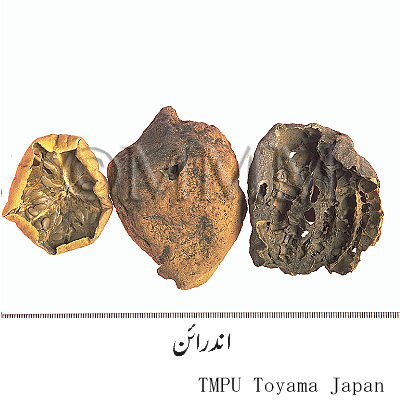 | Market name | Indrayan |
|---|---|---|
| Urudu name | Indrain | |
| Arabic name / Persian name | Hanzal / Kharpaza talkh | |
| English name | Colocynth, Bitter apple | |
| Original plant name | Citrullus colocynthis (L.) Schrad., Colocynth, Bitter apple | |
| Family name | Cucurbitaceae | |
| Used part | Classification | Plant origin | Sub classification | fruit |
| Collection information | Islamic Republic of Pakistan, Karachi [Karachi], Sind , Amjad Unani Medicine (Pvt.) Ltd. , Amjad Unani Medicine (Pvt.) Ltd. | |
| Collection date | 1994/1/22 | |
| Collector | Tsuneo Namba | |
| Identifier | Javed Ahmad | |
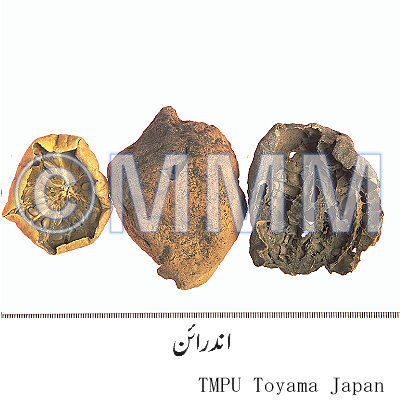
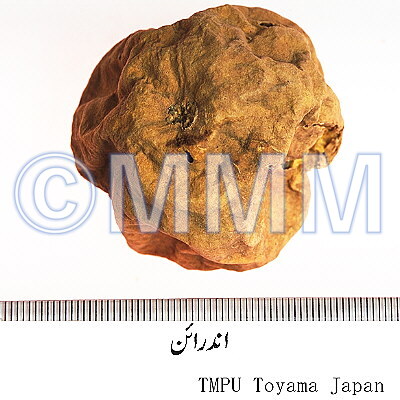
| Description | The drug consists of fruit pulp of C. colocynthis. Features: Dried, semi-ripe fruits, cut into halves or quarters into light and spongy pieces, 3 to 4cm in diameter. Outer surface is smooth, yellowish brown in colour. The cut portion shows greyish white pale yellow pulp in which a number of seeds are embedded. The dry pulp breaks into thin flakes. Seeds are ovoid, flattened, greyish brown in colour and measure 5 to 6mm in length and up to 3mm. in breadth. Odour - none; taste - intensely bitter. The pulp separates from the rind with difficulty. Consequently peeled fruit is seldom found in market. However, the drug should not contain more than 6 and 2 per cent of seeds and epicarp respectively. | |
| TMPW No. | 14517 | |
The capital city, provincial capital city or the representative
location of its administrative area is indicated.
location of its administrative area is indicated.
Production area information
https://ethmed.toyama-wakan.net/img/pin_san.png
25.0700428
67.2847875
Collection information
Islamic Republic of Pakistan,Karachi [Karachi], Sind
https://ethmed.toyama-wakan.net/img/pin_nyu.png
Scientific information data base
| Crude drug name | Urudu name, English name | Indrain, Colocynth, Bitter apple | |||
|---|---|---|---|---|---|
| Arabic name / Persian name | Hanzal / Kharpaza talkh | ||||
| crude drug image |
| ||||
| Original plant name | Citrullus colocynthis (L.) Schrad. | ||||
| Family name | Cucurbitaceae | ||||
| Used part | Fruit pulp | ||||
| Distribution area | Sandy and dry tracts in most parts of India. Grown sometimes along seacoasts to prevent sand drifts. Very common in Delhi parks and wastelands. Upper parts come out in the spring season and dries up by rains. It is also found in Arabia, Greece, Syria, Iran, Africa, France, Spain and Asiatic Turkey. | ||||
| Description | The plant bears small smooth fruits like that of muskmelon. The immature fruits are greenish in colour; the mature ones become orange coloured. Fruit upto 8cm in diameter, globose, variegated; pulp dry, spongy. The pulp is known as Sheham Hanzal. It is mainly used as drug. It has no smell. All parts of the plant are very bitter. The pulp should also not be collected unless the fruit becomes completely yellow leaving no trace of green colour, as otherwise it might be harmful, inferior in quality and fatal. The fruit covering and seeds of hanzal must be avoided. It is also essential that first of all hanzal must be soaked in honey water and then dried and powdered (Avicenna). | ||||
| Function and properties | Cosmetics, Swellings, Joints, Head, Liver, Excretion. Purgative of phlegm and atrabile resolvent, abortifacient, antiflatulent, antiepileptic, antirheumatic, diuretic, expectorant and alterative. Its tender leaves stop bleeding. | ||||
| Specific actions | Drastic purgative, abortifacient, and useful in joint pains. | ||||
| Frequency in use | Abundant. | ||||
| Common uses | Cosmetics: Hanzal is used as a massage in case of leprosy and elephantiasis. Swellings: The tender and fresh leaves of hanzal dissolve swellings and mature their fluids or pus. Joints: It is useful in neuralgia, arthralgia, sciatica and cold gout. Fresh hanzal is plastered on sciatica. Head: Hanzal cleanses the brain. Chest: Vomiting induced by it is very useful in orthopnoea/orthopnea. Liver: The root of hanzal is good for treating dropsy and suitable for stomach. Excretion: It purges thick phlegm and bilious humours out of joints and particularly, the nerves. It is very useful for moist and gaseous colic. It is useful in the diseases of kidneys and bladder. | ||||
| Side effect | The drug produces gripes or colic in the stomach. Green hanzal is highly purgative and emetic. It also causes severe pain which might be fatal. It is taken orally with an equal weight of gum tragacanth. The single fruit of hanzal appearing on its plant is fatal. The root of hanzal is useful in scorpion sting. Similarly its paint is useful. | ||||
| Medical system | Unani | ||||
| Traditional concept | Temperament | It is hot and dry in the second degree (Avicenna and Kabiruddin). | |||
| Drug effect | It is very beneficial in joint pains. But it also produces gripes. It is a well known abortifacient, therefore, must be avoided in pregnancy (all stages) or in irritable conditions of the intestinal canal. | ||||
| Comments | It is in the list of drugs used both in Unani and Ayurvedic Systems of Medicine. | ||||
| Dosage | 1 to 2gm. | ||||
| Substitute | Sibr saqutri (Aloe spp.), for diarrhoea/diarrhea; Amaltas (Cassia fistula), fruit as purgative; Bed-Anjeer (Ricinus communis Linn.), oil as echbolic and Baobarang (Embelia ribes Burm.). | ||||
| Related drugs | According to Saifuddin there is another similar drug which is sold in the Indian bazar under the trade name Kateri-indrayan, It is identified as Ecbalium elaterium A. Rich. (Fam. Cucurbitaceae). It is a native of South Europe and is cultivated in Britain and south Europe (Glossary of Indian Medicinal Plants, p. 103). Qitha al-himmar and Squirting cucumber are its vernacular names in Arabic and English respectively. Both the kinds of Indrayan are used for similar purposes. The extract of this plant is also sold under the name Elaterium. But it is not available from the Unani Attars (Unani pharmacy). In Malta this plant extract is manufactured at a large scale. It is the biggest commercial centre of the extract (Usarah). It is used as a powerful purgative (Saifuddin, Unani Adwiyah Mufradah, p. 50-51). | ||||
| Corrigent (corrective) | Katira (Cochlospermum gossipium DC.), gum and oil of almond. | ||||
| Important compound preparations | Itrifal Deedan and Habb-Ayaraj. | ||||
| References | Reference book Tips! | Glossary of Indian Medicinal Plants, 1956. Chopra, R.N., Nayar, S.L. and Chopra, I.C., Council of Scientific & Industrial Research, New Delhi. - New Edition (1996) National Institute Science Communication; Supplement p 103. Illustrated Manual of Herbal Drugs Used in Ayurveda, 1996. Sarin, Y.K., Council of Scientific & Industrial Research and Indian Council of Medical Research, New Delhi p 238. Indian Materia Medica, Vols. 1-2, 1976 (Repr. 1989). Nadkarni, A.K., Popular Prakashan Pvt. Ltd., Bombay Vol. 1, pp 335-337. Makhzanul-Mufradat (Khawasul Adviyah), Hakeem Kabiruddin, Daftar Al-Masih, Qarol Bagh, Delhi. p 96. Edible Plants of Forestry Origin, 1997. Chandra, V. Indian council of Forestry Research and Education, Dehra Dun. pp 133-135. A Survey of Drugs, 1961 (2nd edi.). Wahid, A. K. and Siddiqui, H. H. Institute of History of Medicine and Medical Research, Delhi. pp 19-36. Dictionary of Economic Plants in India, 1996 (2nd Rep.). Singh, U; Wadhwani, A. M. and Johri B.M. Indian council of Agricultural Research, New Delhi. p 51. Al-Qanun Fil-Tibb. Avicenna. (English translation of the critical Arabic text), Book 2, 1998. Hameed, H. A. (editor), Dept. of Islamic Studies, Jamia Hamdard (Hamdard University), New Delhi. pp 177-179. Al-Jamili Mufradt Al Adwiya Wal Aghziya (1197-1248 A.D.). Ibn al-Baytar. Vols. 1-3, 1985-1999. Central council for Research in Unani Medicine, Janakpuri, New Delhi. Vol. 2, pp 77-80. Hamdard Pharmcopoeia of Eastern medicine, 1969. Said, H. M. (editor), The Times Press, Sadar Karachi. pp 66, 95-96. Indusyunic Medicine, 1997. Usmanghani, K., Saeed, A. and Alam, M. T. Department of Pharmacognosy, Faculty of Pharmacy, University of Karachi, Karachi. pp 162-163. Unani Adwiyah Mufradah, 1984. Ali, Saifuddin, A. (3rd edi.). Taraqi-e-Urdu Bureau, R. K. Puram, New Delhi. pp 50-51. Medicinal plants (in the traditions) of Prophet Muhammad, 1998. Farooqi, M. I. H. Sidrah Publisher, Lucknow. p 84. The Encyclopedia of Medicinal Plants, 1996. Andrew Chavallier, DK Publishing Inc., New York. p 188. | |||
| Remarks | The drug is very easily available and has problem of adulteration. This drug is described by all the Unani physicians. No controversy exists in the botanical source of the drug. On an average the fruit yields 12 to 15 percent of the dry pulp. The Indian varieties of colocynth are nearly globular in shape and usually of the size of an orange or smaller with a surface marbled with green and yellowish white patches. A number of adulterants of C. colocynthis are found in the market. The fruit of Cucumis trigonus Roxb. syn. Cucumis pseudo colocynthis Royle and Cucumis hardwichkii grow abundantly in the mountainous regions of Northern India and are frequently used to adulterate colocynth in the bazar. | ||||
| Last renewal date | 2024/02/28 | ||||