
Crude drug sample data base
※Click on the image to enlarge it.
Crude drug name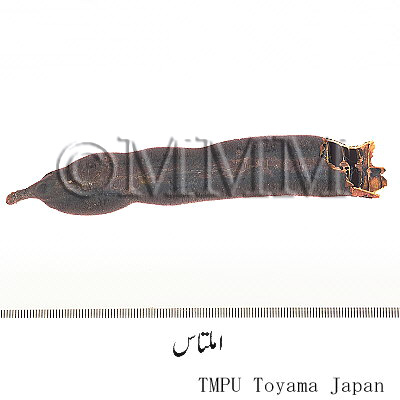 | Market name | Amaltas |
|---|---|---|
| Urudu name | Amaltas | |
| Arabic name / Persian name | Khiyar-shambar / Khiyar-Shambar | |
| English name | Purging Cassia | |
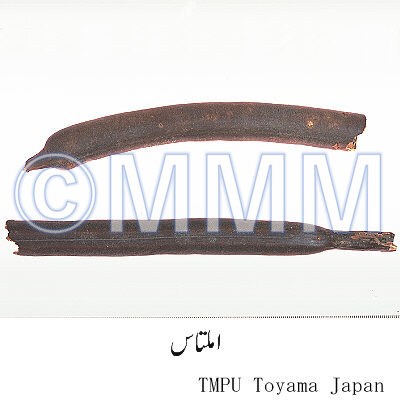
| Original plant name | Cassia fistula Linn., Purging Cassia | |
| Family name | Caesalpiniaceae (Former Leguminosae) | |
| Used part | Classification | Plant origin | Sub classification | fruit |
| Collection information | People's Republic of Bangladesh, Dacca [Dhaka] , Essa Bros. & Co. , Essa Bros. & Co. | |
| Collection date | 1964/3/6 | |
| Collector | Tsuneo Namba | |
| Identifier | Javed Ahmad | |
| Description | Features: Pods cylindrical, dark chocolate brown in colour with a short strong woody stalk and a blunt end suddenly contracted into a point. The oval flattish seed is of reddish-brown colour. The pods' cells contain a soft black pulp which has a mawkish sweet taste. | |
| TMPW No. | 9515 | |
The capital city, provincial capital city or the representative
location of its administrative area is indicated.
location of its administrative area is indicated.
Production area information
https://ethmed.toyama-wakan.net/img/pin_san.png
23.810332
90.41251809999994
Collection information
People's Republic of Bangladesh,Dacca [Dhaka]
https://ethmed.toyama-wakan.net/img/pin_nyu.png
Scientific information data base
| Crude drug name | Urudu name, English name | Amaltas, Purging cassia | |||
|---|---|---|---|---|---|
| Arabic name / Persian name | Khiyar-shambar / Khiyar-Shambar | ||||
| crude drug image |
| ||||
| Original plant name | Cassia fistula Linn. | ||||
| Family name | Caesalpiniaceae (Former Leguminosae) | ||||
| Used part | Fruits | ||||
| Distribution area | Indian laburnum is commonly cultivated tree as an ornamental for attractive yellow blossoms in pendant racemes. Commonly planted as avenue tree in India, Bangladesh and Pakistan. | ||||
| Description | There are two kinds of purging cassia. One is Kabuli and the other is Masri (Egyptian). The best kind is obtained from the brighter and oily stalks. Such stalks are very bright and smooth. Outer coat of pods and inner partitions of pods with seeds (having black and sweet pulp) are used medicinally. | ||||
| Function and properties | Fevers, Chest, Swellings, Joints, Liver. Purgative / cathartic, pulp of the pods-agreeable laxative, seeds emetic. Resolvent of inflammations, emmenagogue. Safe laxative for malhumours. | ||||
| Specific actions | Laxative / purgative (for malhumours), emmenagogue. | ||||
| Frequency in use | Commonly cultivated tree throughout India. | ||||
| Common uses | Fevers: It is also used in hot fevers. Respiration: It is useful in diphtheria, when used as a gargle by the drug soaked in fresh coriander water with the mucilage of the seeds of ispaghula. Chest: Being antiphlegmatic it is useful for relieving thoracic obstructions, heat of the blood, as a safe aperient and demulcent for children and women. It is also given in cough and bronchitis. Swellings: Purging cassia is useful in hot visceral swellings. It is especially beneficial in the swellings of throat when gargled with the juice of garden nightshade. If it is painted on the hard swellings, it proves to be useful. It dissolves the hard swellings. Joints: Purging cassia is painted on gout and painful joints. Liver: It cleanses (the foul humours) the liver and is useful in jaundice and hepatalgia. Kidneys: Confection of the pulp is given in cases of diabetes. Parturition: With saffron and aqua rose, decoction of the pulp is useful in bringing parturition and expelling fetal remnants. Cassia pulp is thus employed as a useful ecbolic and in difficult menstruation. Excretion: It causes relaxation of the bowels and evacuates the burnt bile and phlegm. It is a convenient purgative and proves to be suitable even for pregnant women and relaxes their bowels. | ||||
| Side effect | Excessive use or large doses may cause intestinal irritation, tenesmus, nausea, colic and abortion. | ||||
| Medical system | Unani | ||||
| Traditional concept | Temperament | It is hot and moist in the first degree. | |||
| Drug effect | It is aperient and purgative (for malhumours). It is also phlegmagogue. | ||||
| Dosage | 24 gm to 48 gum. (approximately) | ||||
| Substitute | Turbud (Operculina turpetham (L.) Silva Manso.) and Turanjebin (Alhagi pseudalhagi (Bieb.) Desv.) or (Fraxinus ornus Linn.) for purgation. | ||||
| Corrigent (corrective) | Mastagi (Pistacia lentiscus Linn.), Anisun (Pimpinella anisum Linn.) and butter / oily substances. | ||||
| Important compound preparations | Laooq Sapistan Khiyar Shamberi and Ma‘jun Kalkalanj. | ||||
| References | Reference book Tips! | Glossary of Indian Medicinal Plants, 1956. Chopra, R.N., Nayar, S.L. and Chopra, I.C., Council of Scientific & Industrial Research, New Delhi. - New Edition (1996) National Institute Science Communication; Supplement p 54. Makhzanul-Mufradat (Khawasul Adviyah), Hakeem Kabiruddin, Daftar Al-Masih, Qarol Bagh, Delhi. pp 89-90. Dictionary of Economic Plants in India, 1996 (2nd Rep.). Singh, U; Wadhwani, A. M. and Johri B.M. Indian council of Agricultural Research, New Delhi. p 44. Al-Qanun Fil-Tibb. Avicenna. (English translation of the critical Arabic text), Book 2, 1998. Hameed, H. A. (editor), Dept. of Islamic Studies, Jamia Hamdard (Hamdard University), New Delhi. p 202. Hamdard Pharmcopoeia of Eastern medicine, 1969. Said, H. M. (editor), The Times Press, Sadar Karachi. pp 248, 281. Indusyunic Medicine, 1997. Usmanghani, K., Saeed, A. and Alam, M. T. Department of Pharmacognosy, Faculty of Pharmacy, University of Karachi, Karachi. pp 143-144. | |||
| Remarks | Post-amaltas (outer covering of pod) and Maghz-amaltas (inner pulp of the pod with seeds) are used separately in Unani system of medicine. According to Hakim Kabiruddin the outer covering of the pod is hot and dry in second degree. Post-amaltas is mainly used in the retention of menses. Its decoction is also given to pregnant women for making delivery easy. Its dosage is from 6 gm to 12 gm. According to Unani physicians the heating of the fruit pulp decreases its potency. | ||||
| Last renewal date | 2024/02/22 | ||||