

Crude drug sample data base
※Click on the image to enlarge it.
Crude drug name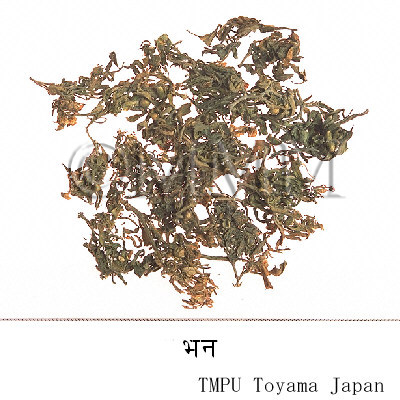 | Market name | Bhan |
|---|---|---|
| Formal name | Bhanga | |
Other names Tips! | Bhang, Charas, Ganja (B), Bhang, Charas, Ganja (H), Bangi (K), Kanchanchotti (M), Ganjai, Kaopam-chettu (Te), Bhangi, Ganja (Ta), Bhang, Bhango, Cares, Gajima, Ganja (N) | |
| English name | Soft Hemp, True Hemp | |
| Original plant name | Cannabis sativa L. (= Cannabis indica Linn.), Soft Hemp, True Hemp | |
| Family name | Cannabaceae | |
| Used part | Classification | Plant origin | Sub classification | flower + leaf |
| Collection information | Kingdom of Nepal, Kathmandu | |
| Collection date | 1963/11/25 | |
| TMPW No. | 8794 | |
The capital city, provincial capital city or the representative
location of its administrative area is indicated.
location of its administrative area is indicated.
Production area information
https://ethmed.toyama-wakan.net/img/pin_san.png
27.7172453
85.3239605
Collection information
Kingdom of Nepal,Kathmandu
https://ethmed.toyama-wakan.net/img/pin_nyu.png
Scientific information data base
| Crude drug name | Ayurvedic name or Sanskrit name, English name | Bhanga, Soft Hemp, True Hemp | ||
|---|---|---|---|---|
| Synonyms | Bhanga, Ganja, Matulani, Madani, Vijaya, Jaya, Ranjika, Gancakini, Bahuvadini, Tandrakrt, Mathu. | |||
| crude drug image |
| |||
| Original plant name | Cannabis sativa L. (= Cannabis indica Linn.) | |||
| Family name | Cannabaceae | |||
| Used part | Leaves and Flowers | |||
| Distribution area | An annual plant wild throughout the western Himalayas, and is also cultivated in this and adjoining region. | |||
| Remarks | Cultivated under regulation but also found wild. | |||
| Common uses | Cannabis drugs have been used in India from ancient times. The drugs - bhang, ganja, and charas - commonly used in India, are derived from the flowers, leaves and the resinous matter obtained from them. Bhang, when taken orally in small doses, stimulates appetite and digestion but their prolonged use leads to loss of appetite. They are prescribed in dyspepsia, colic and diarrhoea/diarrhea along with other drugs. Leaves are bitter, astringent, tonic, aphrodisiac, antidiarrhoeic, intoxicating, stomachic, analgesic and arbotifacient. They are used in convulsions, otalgia, abdominal disorders, diarrhoea/diarrhea, stomatalgia, and haematorrhoea/hematorrhea. The leaves are useful in leprosy and they cause biliousness, intoxication and hallucination. Bark is tonic and is useful in inflammations, haemorrhoids/hemorrhoids and hydrocele. Seeds are carminative, astringent, aphrodisiac, antiemetic and anti-inflammatory. Its excessive use causes dyspepsia, cough, impotence, melancholy, dropsy, hyperpraxia and insanity. Cannabis is recommended as a psychiatric aid in treating depression and high blood pressure. It is useful in treating glaucoma by reducing intra-ocular hypertension. It has proved favourable in treatment of extreme nausea in patients undergoing cancer therapy. It is also prescribed in treating menstrual disorders and during labour pains. | |||
| Therapeutic uses | Agnimandya (loss of appetite), Sula (colic), Sukrasrava (spermatorrhoea/spermatorrhea), Atisara (diarrhoea/diarrhea), Annasula (pain in the abdomen), Ajirna (indigestion), Arsas (haemorrhoids/hemorrhoids), Bhutanasa (removes ill effects of invisible forces), Kasa (cough), Vyatha (depression). | |||
| Chemical constituent | The hallucinogenic effects are associated with the tetrahydrocannabinols present. Several cannabinoids have been isolated from the resinous exudate of the plant. Most of the cannabinoids are oily in nature and have the n-pentyl side chain. They are: tetrahydrocannabinol (THC), cannabidiol, cannabinol, cannabichromene, cannabigerol, cannabielsoin, stereo isomers of cannabitriol, 8, 9-dihydroxy-D6a(10a)-THC, (-)-10-ethoxy-9-hydroxy-D6a(10a)-THC, cannabinodiol, cannabicumaronone, cannabiglendol and cannabitetrol. In natural form, tetrahydrocannabinol (THC) exists in many isomeric forms, viz. (-)D9- trans -THC (D9-THC; D1-THC); D9- cis -THC and D8- trans -THC (D8-THC ; D1(6)-THC); D3- and D5-isomers of THC have also been isolated. Besides the cannabinoids, the plant also contains several non-cannabinoid phenols: cannabispiran (cannabispirone), isocannabispiran, dehydrocannabispiran (cannabispirenone), s-cannabispiranol (cinnabispirol), acetylcannabispirol, cannabispiradienone (spirad-ienone), canniprene (C21H2604), 3-[2-(4-hydroxy-phenyl)ethyl]-5- methoxyphenol, 3-[2-(3-hydroxy-4-methoxyphenyl) ethyl]-5- methoxyphenol, 3-[2-(3-isoprenyl-4-hydroxy-5-methoxyphenyl) ethyl]-5-methoxyphenol, cannabistilbene- I (C20H24O3) and-II (C17H20O5), cannithrene-I (C15H14O3) and -II (C16H16O4) and 3,5,4'-trihydroxybibenzyl. The methyl ether of the last compound shows estrogenic activity. The flavonoids isolated from the plant are: flavocannabiside, flavosativaside,orientin, vitexin, 2"-O- glucopyranosyl-orientin, 2"-0-glucopyranosyl-vitexin, cytisoside, a C-glycuronide of luteolin, geranylated and prenylated chrysceriols, cannflavin A and B, canniflavone-I and -II, and 3- 0-diglucosides of kaempferol and quercetin. Presence of blumeol A (vomifoliol) and B (dihydrovomifoliol) is also reported. The oil from the male plants had the following physicochemical constants: d 20-degree 20-degree, 0.9012; n D20-degree, 1.495; [a] D20-degree, - 11.8-degree; and acid val, 1.24 and contained several mono- and sesquiterpenes. The main constituents identified are: s-caryophyllene, s-humulene, a-sellinene, a-bergamotene, s-farnesene, limonene, s- phellandrene, caryophyllene oxide, a- pinene, myrcene, and g-terpinene. Caryophyllene, the major constituent of the oil, on exposure is rapidly converted into its epoxide and is responsible for recognition of charas by police dogs. | |||
| Pharmacological effect | Cannabidiol and cannabinol exhibited activity similar to D9-THC on intracerebral administration in mice. Cannabis drugs resemble cocaine and amphetamine in their euphoric and sympathomimetic activity, and morphine in its euphoric and analgesic activity. The spontaneous activity gets depressed but animals become hypersensitive to external stimuli, such as sound or touch. Though their effects are largely confined to the CNS, they sometimes produce vomiting and diarrhoea, fibrillary tremor and ataxia. Blood pressure and respiration are lowered but heart rate increases. | |||
| Medical system | Ayurveda (Traditional Indian medicine) | |||
| Traditional concept | Rasa (Taste) | Tikta (Bitter) | ||
| Virya (Potency) | Usna (Hot) | |||
| Guna (Quality) | Laghu (Light), Tiksna (Sharp) | |||
| Vipaka (Post digestive taste) | Katu (Pungent) | |||
| Prabhava (Special action) | Madaka | |||
| Karma (General action) | Madani (causes intoxication), Harsadayini (causes exhilaration), Nidrajanani (causes sleep), Tandrakari (causes drowsiness), Grahini (constipating), Pacani (digestive), Ksuddipani (appetiser), Sukra stambhaka (inhibits semen flow), Vicitranandajanani (causes hallucination). | |||
| Dosakarma (Action on dosa) | Decreases Vata Kapha, increases Pitta | |||
| Dhatukarma(Action on body tissues) | Sukrastambhaka (stops semen flow) | |||
| Traditional usage | 1. Powder of Bhanga (Cannabis) and parched Bengal gram mixed with jaggery is given before the time of advent. It checks fever with rigor. 2. Bhanga and Jatiphala (Myristica fragrans) in equal parts mixed with Indrayava (Holarrhena pubescens) in double quantity is made into a linctus. It checks diarrhoea/diarrhea. 3. Bhanga mixed with latex of Udumbara (Ficus glomerata) is made into pills. It checks diarrhoea/diarrhea. 4. Arka (Calotropis procera) distilled from Bhanga and Yavani (Trachyspermum ammi) promotes digestive fire. 5. Bhanga is collected in auspicious day and powdered. It should be taken with honey and ghee. It destroys kustha (skin diseases) and promotes life span. 6. Leaves of Bhanga, Vrddhadaruka (Argyria speciosa) root and Simsapa (Dalbergia sissoo) with these the affected part is anointed. It removes freckles etc. 7. Indrasana pancaga (a formulation) is used as rasayana (rejuvenative). It contains Bhanga. 8. Fried Bhanga powder should be taken with honey in night. It is useful in sleeplessness, diarrhoea/diarrhea, grahani (sprue) disorder and loss of digestive fire. | |||
| Formulation | Jatiphaladi curna, Madanananda Modaka. | |||
| Comments | As it is a narcotic drug, it needs purification before consumption. It is given sudation for three hours in cow's milk. Later it is dried. Then the powder is fried on mild fire with ghee. This process reduces its harmful effects. The narcotic drugs Bhang, Ganja and Charas are the dried flowering and fruiting tops of this plant. It affects cerebrum and makes him lose self control. In larger doses, they produce coma and death from cardiac failure. In medicine hence it has to be used cautiously and after purification. Its synonyms madini, madika indicates that it causes intoxication. Tandrakrt indicates that it causes drowsiness. Bahuvadini means it results in delirium. | |||
| References | Reference book Tips! | [2] Indian Medicinal Plants - A Compendium of 500 species, Varier, P.S., Orient Longman Ltd. Chennai (Madras) Vol. 1 (Repr.1996), pp 356-360. Indian Medicinal Plants (Second Edition), Vols. 1-5, 1993. Kirtikar, K.R. and Basu. B.D., Periodical Experts Book Agency, Delhi Vol. 3, pp 2302-2303. Plants in Ayurveda (A Compendium of Botanical and Sanskrit Names), 1997. Abdul Kareem, M., Foundation for Revitalisation of Local Health Traditions, Bangalore 28. Dravyagunavijnana, Vols. 1-5, reprint 1998. Sharma, P.V., Chowkhambha Bharati Academy, Varanasi Vol. 2, pp 25-28. Classical uses of Medicinal Plants, 1996. Sharma, P.V., Chaukhambha Visvabharati, Varanasi p 657. | ||
| Remarks | Cannabis is cultivated for its narcotic resin, fiber, and seed. But the plants cultivated for fiber and seed are not used simultaneously for extracting the narcotic resin. Also known as Siddhi, sabji or path, bhang consists of the dried, crushed mature leaves and flower shoots of the male and/or female plants. Ganja: It is prepared from the flowering and/or fruiting tops of Cannabis sativa which are coated with a resinous exudate. Charas or hashish: It is the resinous matter collected from the leaves and flowering tops of the female plants. Both ganja and charas are usually smoked to induce a state of intoxication. The variation in Cannabis sativa is considerable, following mainly two patterns on the basis of which two widespread types are discernible. These have been raised to the rank of subspecies, viz. sativa L. and indica (Lam.) Small & Cronq. subsp. sativa has a northern distribution (above 30-N) with a relatively limited potential for the production of the intoxicant material but with more of fibre and oil. It comprises two varieties - var. sativa including the cultivars grown for fibre and oil and var. spontanea Vavilov cultivated in Nepal for its fibre. | |||
| Last renewal date | 2023/11/16 | |||